Skip to content

Spiti Valley Travel Guide: Monasteries, Villages, Routes and Seasons

Spiti Valley is a high-altitude cold desert in the Lahaul and Spiti district of Himachal Pradesh, near the Tibet border. The main places to visit in Spiti Valley are the monasteries of Key, Tabo and Dhankar, the villages of Kibber, Langza and Komic, and the Pin Valley National Park. The Shimla–Kinnaur road to Kaza is open almost all year; only the Kunzum route from Manali closes for winter.

By Experience My India Editorial Team · Reviewed by Experience My India Editorial Team · Updated 1 Sept 2026

See all 1 tour or experience in Spiti Valley →

Government-approved operatorApproved by the Ministry of Tourism, Government of India

Places to visit in Spiti Valley

Spiti, which Himachal Tourism translates as "the middle land", is the Spiti sub-division of Lahaul and Spiti district, with its headquarters at Kaza. The Spiti River rises at the foot of the Kunzum range and flows east to join the Sutlej at Khab in Kinnaur; the monasteries and villages below lie along it or up its side valleys.

Kaza

Kaza, on the left bank of the Spiti River, is the valley's largest settlement, its administrative headquarters and the usual base for a trip. It has a bank, an ATM, a post office, a petrol and diesel station, the valley's Community Health Centre and a market with a few restaurants. Key Monastery and the villages of Langza, Hikkim and Komic are all within about 20 km, so they make easy day trips from here.

Key Monastery

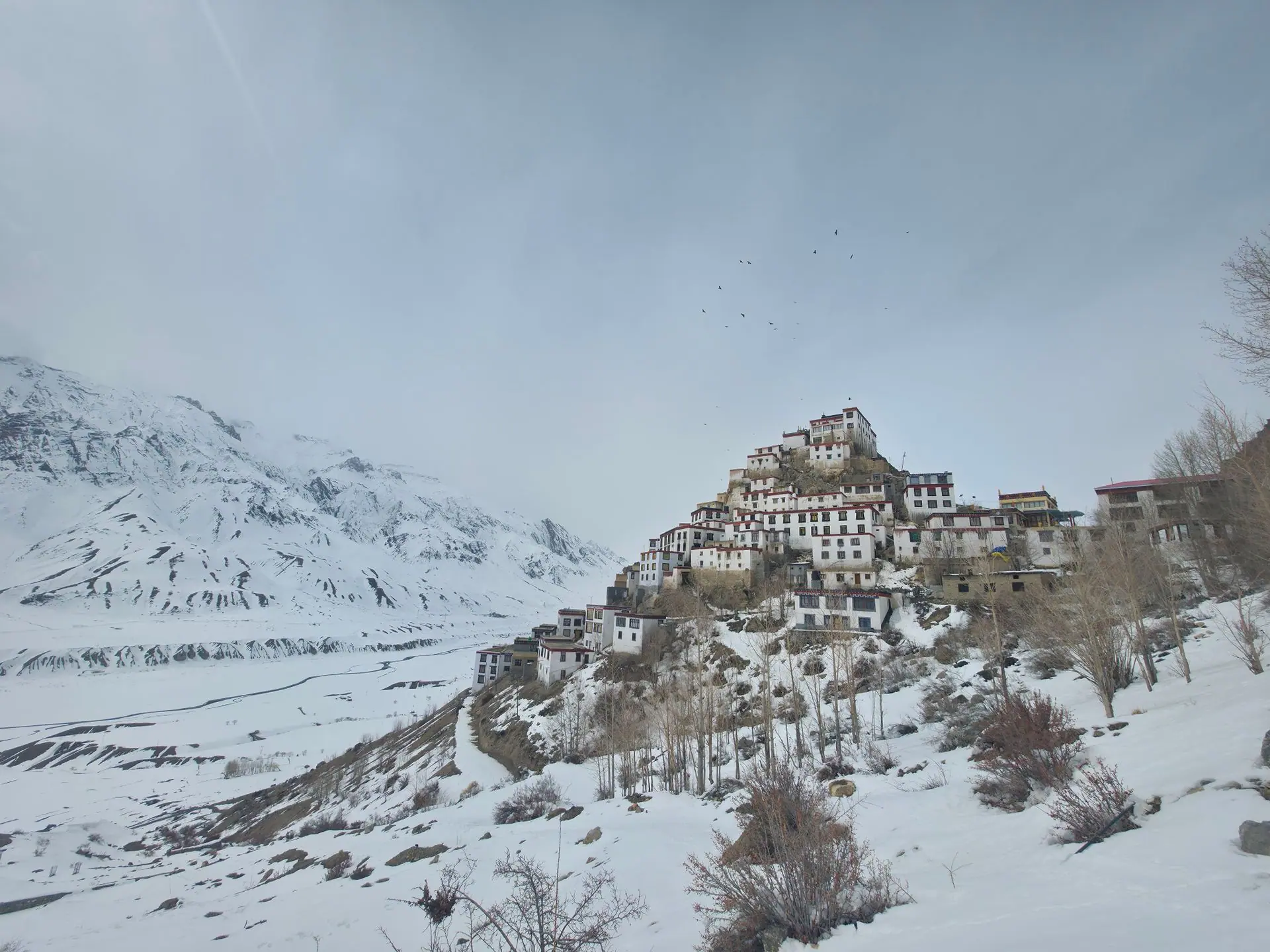
Key (also spelt Ki or Kye) Monastery rises on a conical hill about 12 km from Kaza, at about 13,500 ft (roughly 4,100 m). Its low rooms, dark corridors and steep stairs hold murals, thangkas, rare manuscripts, stucco images and old wind instruments, and its library keeps manuscripts of the Tangyur. Scholars differ on its age, but the district notes that most agree it was built before the 15th century. Monks perform the masked chham dance here in summer, when the monastery holds its festival.

Kibber

Kibber, 16 to 18 km from Kaza by the two official counts, stands above 4,000 m on a limestone ridge, and its houses are built of stone rather than the mud brick used elsewhere in the valley. A bus runs from Kaza in summer. The village is a base for high-altitude treks and the gateway to the Kibber Wildlife Sanctuary, about 1,400 sq km of cold desert with blue sheep and ibex; Himachal Tourism describes the country around Kibber as snow leopard habitat. There is a civil dispensary and a post office.

Langza, Hikkim and Komic

Three high villages lie close together above Kaza. Langza, about 16 km away, is watched over by a large statue of the Buddha facing the Chau Chau Kang Nilda peak, and is known for ammonite fossils, clay pottery and handmade carpets and shawls. A road continues to Komic, which at about 4,400 m is one of the highest villages reached by a motorable road, with the Tangyud monastery of the Sakya sect, founded in the early 14th century and moved to its present site after the 1975 earthquake. Hikkim is reached from Komic.

Tabo Monastery

Tabo, a village of apple orchards on the Kinnaur road, 46 to 48 km below Kaza, holds Spiti's largest monastic complex, the Chos-khor or "doctrinal enclave", founded in 996 by the translator Rinchen Zangpo. Its nine temples, 23 chortens and monks' and nuns' quarters are known for murals and stucco sculpture that have earned it the name "Himalayan Ajanta", and caves in the cliff above were used by monks for meditation. At about 10,000 ft (3,050 m), Tabo is lower than Key, Kibber or Komic, so it suits a first night on the way up from Kinnaur.

Dhankar

Dhankar, between Tabo and Kaza on a 7 km branch road from Shichling, was once the capital of Spiti. Its monastery and old citadel stand on a spur that ends in a precipice above the left bank of the Spiti River; the fort served as the seat of the Nono, Spiti's hereditary ruler, and the monastery keeps scriptures in the Bhoti script. Dhankar is also the starting point for Dhankar Lake and for the Pin Valley.

Pin Valley National Park

The Pin Valley meets the Spiti River at Attargu, about 10 km from Shichling, and the whole valley is a national park; the state declared its intention to make it one in 1987, and it is the only national park in Himachal Pradesh set in cold desert. It protects snow leopard, ibex, bharal (blue sheep) and red fox, and the valley breeds the sure-footed Chamurti horses. The Kungri monastery, from the 14th century and the main centre of the Nyingma sect in Spiti, stands in its buffer zone, and the village of Mudh lies further up the valley.

Kunzum La, Losar and Chandratal

On the road from Manali, the Kunzum La, over 4,500 m, is the gateway between Lahaul and Spiti; a chorten of stones and a temple mark the top. Losar, at 4,085 m, is the first village on the Spiti side. Back in the upper Chandra valley, Chandratal, the "lake of the moon" at 4,337 m, is a protected Ramsar wetland, reached by a side road from Batal or on foot from the Kunzum. Both can be visited only while the Kunzum road is open, usually from June or July to October or November.

Things to do in Spiti Valley

See it on a loop. Our Spiti Valley circuit goes in by one route and, where the season allows, out by the other, with a private vehicle and driver, a local guide who knows Spiti's roads and monasteries, accommodation in Kaza and the villages, and monastery entry where it applies. It suits travellers comfortable with long drives and basic rooms in the remoter villages.

Go for a festival. Masked dances are performed at monasteries including Key, Tabo and Mane, generally in June; the Kungri monks' dance falls in July; and the Ladarcha fair, once a barter fair for traders from Ladakh, Rampur-Bushahr and Spiti, is now held at Kaza, generally in the third week of August. Losar, the new year, is usually in February.

Watch for wildlife. Herds of blue sheep and ibex can be seen around Kibber, and the district's Pin Valley page names April, May, November and early December as good times for sightings, when animals come lower.

Eat local. Spiti's food is Tibetan in style: thukpa, momos and barley-flour dishes such as thuktal and shunali, with salted butter tea and the local brew, chhang.

Walk high. Treks cross high passes to Kullu, Ladakh and Kinnaur (see the FAQ below); see also trekking experiences in Himachal Pradesh. Every trip we run here is on Spiti Valley tours and experiences.

Best time to visit Spiti Valley

Summer, from about mid-May to mid-October, is the main season: the district names it the best time to visit, and Himachal Tourism calls April to October a good time, with May and June days around 15–20°C. Spiti lies in the rain shadow of the Himalaya and gets little monsoon rain, but the district rates its landslide and flood risk as high, and the Kinnaur district warns that its road can be blocked in the rainy season, so leave a spare day in July and August.

The Kunzum road from Manali usually opens in June or July and closes again in October or November, so the full loop, and Chandratal, depend on those months. By September Himachal Tourism recommends heavy woollens for the cold evenings.

Winter is a different trip. Himachal Tourism says temperatures can fall to about minus 20°C between December and February. The Shimla–Kinnaur road stays open almost all year, subject to the weather, but the Kunzum route and Chandratal are closed, the Pin Valley is hard to reach from December to March, and regular buses run only until October. Monastery festivals cluster between June and August.

How to reach Spiti Valley

From Shimla, through Kinnaur: this is the route the district calls an almost all-weather road connection to Kaza, subject to the weather and road conditions. It enters Spiti at Sumdo and passes Tabo before Kaza; Shimla to Kaza is about 412 km, roughly 20 hours of driving without counting an overnight halt. Our circuit describes it as the longer but more reliable approach, gaining height gradually; our Shimla travel guide covers the start.

From Manali, over the Kunzum La: since 3 October 2020, the 9.02 km Atal Tunnel, Rohtang, has linked Manali with the Lahaul and Spiti valley all year, so the old Rohtang Pass road is no longer needed. Beyond the tunnel the road follows the Chandra valley past Batal, crosses the Kunzum La and comes down through Losar to Kaza. The Kunzum section is generally closed from about October or November to June or July, and the dates move with the snow each year; see our Manali travel guide.

By air and rail: the nearest airports are Bhuntar (Kullu) and Shimla, with flights from Delhi and Chandigarh; the nearest broad-gauge stations are Chandigarh and Kalka, and narrow-gauge lines reach Shimla and Jogindernagar, with the rest by road. Regular buses run from Shimla via Kinnaur between May and October and from Manali between July and October.

How many days in Spiti Valley

Count the driving first. From Shimla, the district's 20 or so hours to Kaza means two days on the road with an overnight halt, and the way out takes about as long. Then give the valley at least two full days from Kaza: one for Key and Kibber, one for Langza, Hikkim and Komic. Tabo and Dhankar fit into the drive along the Kinnaur road, and the Pin Valley needs a day of its own.

Our Spiti circuit runs the loop in six days: two days in, a day at Kaza and Key, a day for Kibber and Langza, and two days out. Add a day or two for the Pin Valley or a slower pace at altitude. Whatever the length, climb slowly: the district's travel advisory carries the line "Gain Altitude Slowly. Gain Memories Safely", and its trekking advice is to allow enough time to acclimatise. Read our altitude sickness guide before you go, and see the Himachal Pradesh travel guide and our Himachal Pradesh tour packages to combine Spiti with the rest of the state.

Tips for travelling in Spiti

Permits: Indian citizens do not need a permit for Spiti. Foreign nationals need a Protected Area Permit for the stretch near the Tibet border, which includes Tabo and Dhankar and the Kinnaur road into the valley at Sumdo. Permits are issued to foreign tourists travelling as a group arranged by a recognised Indian travel agency, by offices including the SDM at Kaza, the district office at Keylong and the office at Reckong Peo in Kinnaur. Official pages differ on details such as group size and whether Kaza itself is covered, so confirm the rule before you set out.

Health: medical help is limited to a Community Health Centre at Kaza, a Primary Health Centre at Tabo and a civil dispensary at Kibber, and the district advises carrying essential medicines.

Phone, cash and fuel: mobile coverage varies, with BSNL at Kaza and Jio 4G in parts of Spiti. Kaza has the valley's bank, ATM and fuel station, so carry cash for the villages and, as the district advises, plan fuel in advance.

Roads and clothes: check the district's road status and travel advisories before each leg, especially in winter and the changeover months, and pack warm layers even in summer, as Himachal Tourism says the valley stays cold all year.

Why book with Experience My India

  • Government-approved operator

    Approved by the Ministry of Tourism, Government of India

  • 500+ vetted local guides

    35+ destination specialists plan every trip by hand.

  • Human help, every day

    Mon–Sun, 9:00 AM – 9:00 PM IST · +91 73022 65809

  • No payment until you approve

    You receive a written quote first; nothing is charged to start planning.

Frequently asked questions

Where is Spiti Valley?

Spiti Valley is in Himachal Pradesh, in the Lahaul and Spiti district, with Kaza as its headquarters. It follows the Spiti River, which flows east to join the Sutlej at Khab in Kinnaur. The Kunzum La is its gateway from Lahaul to the west, the Parang La trail links it with Ladakh, and its lower end around Tabo and Sumdo lies near the Tibet border.

What is Spiti Valley famous for?

Its Buddhist monasteries, such as Tabo, founded in 996 and known for its murals and stucco figures, and Key, on its hill above Kaza; high villages such as Kibber, Langza and Komic; and cold-desert landscapes at well over 3,000 m. It is also known for the snow leopard country around Kibber and the Pin Valley, the fossils of Langza and the Chamurti horses of the Pin Valley.

How high is Spiti Valley?

Most of the valley lies well over 3,000 m, Himachal Tourism says. Official figures put Tabo at about 10,000 ft (3,050 m), Key Monastery at about 13,500 ft (4,100 m), Kibber above 4,000 m, Losar at 4,085 m and Komic at about 4,400 m. On the Manali road, the Kunzum La is over 4,500 m, and Chandratal lies at 4,337 m. Climb gradually and allow time to acclimatise.

What is Spiti Valley like in winter?

Very cold and very quiet: Himachal Tourism says temperatures can fall to about minus 20°C between December and February. Kaza can still be reached by the Shimla–Kinnaur road, open almost all year subject to the weather, but not over the Kunzum La; Chandratal is closed off, and the Pin Valley is very difficult to reach from December to March.

What is the nearest airport to Spiti Valley?

Bhuntar, the Kullu airport, is the nearest airport named by the Lahaul and Spiti district; Himachal Tourism also lists Shimla, with flights from Delhi and Chandigarh to both. From either, the rest of the journey is by road: from Bhuntar through Manali and over the Kunzum La when it is open, or from Shimla through Kinnaur, about 20 hours of driving to Kaza.

Is Spiti Valley a trek?

No. Spiti is reached and toured by road, and our circuit is a road trip by private vehicle. But the valley is also trekking country: high passes link it with Kullu's Parvati valley (the Pin–Parvati pass, 5,400 m), with Ladakh (the Parang La, 5,580 m) and with Kinnaur (the Bhaba pass, 4,865 m). These are serious high-altitude routes, and the district advises acclimatisation, proper equipment and local guidance.

Where should you stay in Spiti Valley?

Kaza, the largest settlement and the usual base, has a bank, an ATM and fuel and is closest to Key, Kibber, Langza and Komic. Tabo suits a night on the way in or out along the Kinnaur road. Rooms in the remoter villages are basic; our Spiti circuit stays in Kaza and in the villages.

Tour packages in Spiti Valley

See all
From the journal: Spiti Valley

Customer reviews

Experience My India is rated 4.3 on Tripadvisor. We publish guest reviews after each trip.

Read our reviews

Plan a trip

Tailor-made quote from a specialist