Skip to content

Darjeeling Travel Guide: Places to Visit, the Toy Train and Planning

Darjeeling is a hill town in West Bengal at about 2,000 metres, known for its tea, the UNESCO-listed Darjeeling Himalayan Railway and views of Kangchenjunga, the world's third-highest mountain. Its main sights are Tiger Hill, Batasia Loop, the Peace Pagoda and the tea estates. Fly to Bagdogra or take a train to New Jalpaiguri, allow two to three days, and expect the clearest views from October to December.

By Experience My India Editorial Team · Reviewed by Experience My India Editorial Team

See all 1 tour or experience in Darjeeling →

Government-approved operatorApproved by the Ministry of Tourism, Government of India

Places to visit in Darjeeling

Darjeeling sits on a ridge in the Lesser Himalayas, and its sights fall into three groups: viewpoints around the town, the railway and the villages along it, and the tea estates and monasteries below the ridge. The Darjeeling district administration lists the town at 2,042 metres.

Tiger Hill

Tiger Hill, 13 km from the town and 2,590 metres high, is the sunrise viewpoint. West Bengal Tourism says the sun rises behind Kangchenjunga and the Eastern Himalaya, and that on a clear day Mount Everest is also visible. The district adds that Everest is only just visible, while Kangchenjunga looks higher because it stands much closer. Start before dawn, wear warm layers, and expect cloud on many mornings outside the clear months.

Batasia Loop

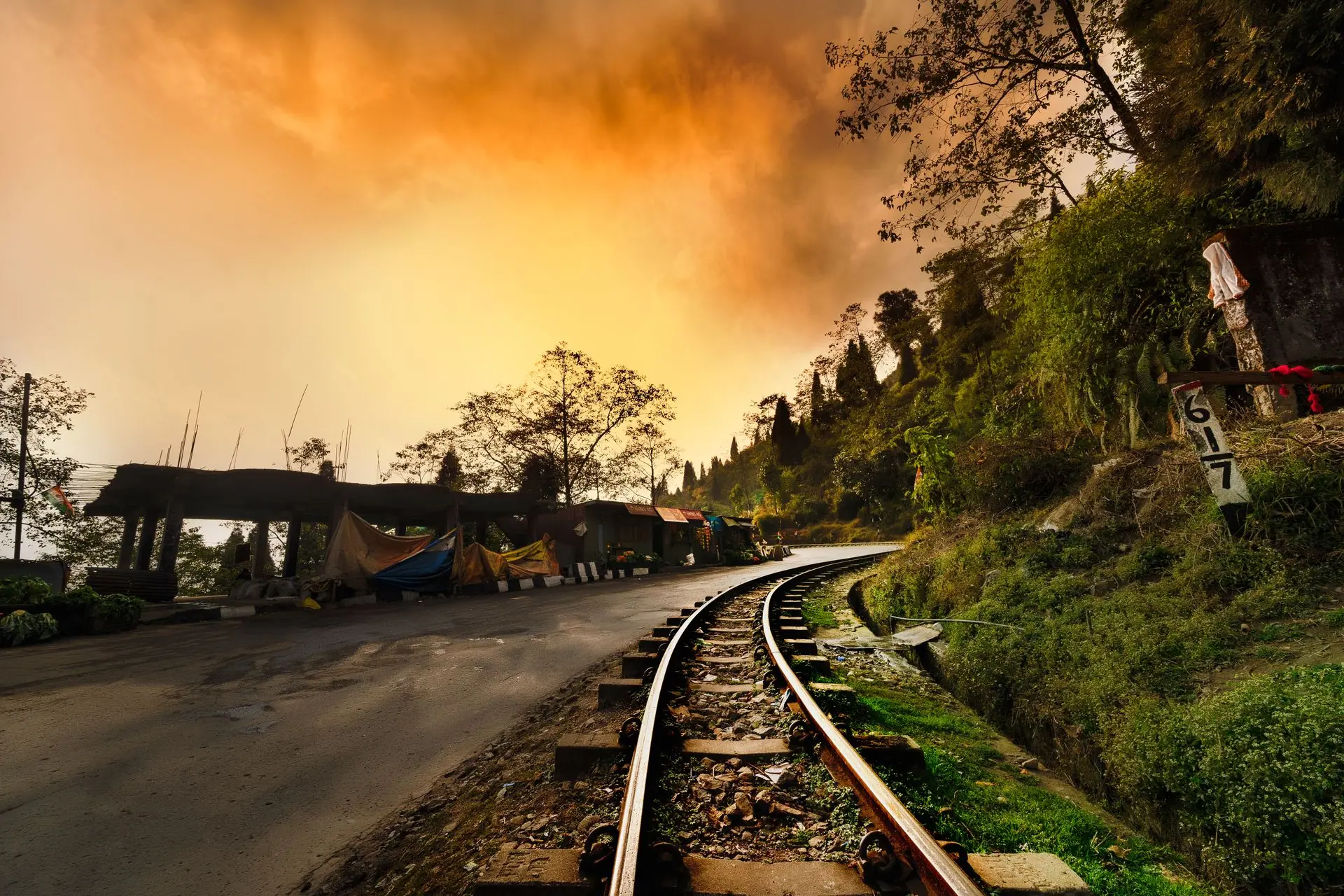
On the toy train line, about 5 km from Darjeeling, Batasia Loop is where the track circles a hill to lower the slope, and West Bengal Tourism describes it as a work of art by the engineers. The district says the line almost imperceptibly circles and descends 1,000 feet. In the middle stands the Gorkha War Memorial, in memory of Gorkha soldiers, set in a garden with views of Kangchenjunga and other peaks. Sellers offer handicrafts and woollens around it.

The Mall and Observatory Hill

The Chowrasta, or Mall, is the heart of the town and a no-vehicle zone, which livens up in the evening, when locals and visitors stroll, shop at roadside stalls and eat street food. Pony rides run around it. Above it, Observatory Hill carries the Mahakal temple and gives views of Kangchenjunga; the district says the view is clear in October and November, and at other times cloud sometimes covers it.

The Darjeeling Himalayan Railway

UNESCO inscribed the Darjeeling Himalayan Railway in 1999, and now lists it with two other lines as the Mountain Railways of India; it calls the railway the first, and still the most outstanding, hill passenger railway. Its 88.48 km of 2-foot gauge track joins New Jalpaiguri with Darjeeling, passing Ghoom at 2,258 metres, with six zigzag reverses and three loops. The line opened in 1881. Indian Railways runs a joy ride from Darjeeling to Ghum and back, with a 10-minute stop at Batasia Loop and 30 minutes at Ghum for the Rail Museum.

Ghoom

About 6 km from Darjeeling, Ghoom (also spelt Ghum) is known for its Buddhist monasteries among the hills. It is the summit of the railway, and the station has a museum beside it that railway enthusiasts will want to see. The joy ride stops here for half an hour. West Bengal Tourism and Indian Railways both call it the highest railway station in India; UNESCO gives its altitude as 2,258 metres, and Indian Railways calls it the line's summit.

Peace Pagoda

The Peace Pagoda stands on the slopes of Jalapahar, a few kilometres from the town. It was built under the guidance of Nichidatsu Fujii, the Japanese Buddhist monk who founded the Nipponzan-Myohoji order, and is 28.5 metres high and 23 metres across. It houses four avatars of the Buddha, including Maitreya. The foundation stone was laid in 1972, and it was inaugurated in 1992.

Himalayan Mountaineering Institute and the zoo

Prime Minister Jawaharlal Nehru founded the Himalayan Mountaineering Institute on 4 November 1954 to mark the first ascent of Mount Everest by Tenzing Norgay and Edmund Hillary. The Padmaja Naidu Himalayan Zoological Park, set up in 1958 in the Birch Hill area, keeps Himalayan species such as snow leopards, gorals and Siberian tigers. Tenzing Rock and Gombu Rock, on Lebong Cart Road, are named after Tenzing Norgay and his nephew Nawang Gombu.

Happy Valley Tea Estate

Established in 1854, Happy Valley is Darjeeling's second-oldest tea estate and the closest to town, 3 km to the north. The district says it covers 177 hectares at about 2,100 metres and is open Tuesday to Saturday, 8 am to 4.30 pm, with March to May the busiest months, when plucking and processing are in progress. The Tea Board says 87 estates hold Darjeeling Tea status under its geographical indication.

Monasteries and the Tibetan Refugee Self-Help Centre

Bhutia Busty monastery, which belongs to the Red Sect (Nyingma) and was first on Observatory Hill, keeps old Buddhist scripts, with one of the original pieces of the Book of the Dead as its prized possession. At Lebong, the Tibetan Refugee Self-Help Centre, locally called the Hermitage, began in 1959 to relieve refugees arriving from Tibet, and its main activity today is the making of handicrafts. Other monasteries stand at Ghoom.

Lloyd Botanical Garden and Senchal

Lloyd Botanical Garden was established in 1878 on 40 acres. Senchal Wildlife Sanctuary, 10 to 15 km from the town, is one of the oldest sanctuaries in India, covering 38.6 sq km between 1,500 and 2,600 metres, with barking deer, wild boar, Himalayan black bears, leopards and many birds. The two Senchal lakes supply Darjeeling's drinking water. Tiger Hill is close to the sanctuary.

Things to do in Darjeeling

Watch the sunrise from Tiger Hill, ride the toy train, stroll the Mall in the evening, walk through a tea estate and visit a monastery. West Bengal Tourism adds trekking routes and campsites from the town. Our Darjeeling toy train experience includes transfers to and from the station, a local guide and standard joy-ride tickets; the ride is seated and gentle, needs no acclimatisation or particular fitness, and is built in alongside the town's tea gardens and viewpoints. Everything we run in the hills is on the Darjeeling destination page, and our toy trains and railways page covers the other heritage lines.

Best time to visit Darjeeling

The driest, clearest months are October to December, with March also clear. IMD's observatory at Darjeeling records clear skies at 8.30 am on 10 days in October, 13 in November, 14 in December and 15 in March, against 2 in July. Rain follows the same pattern: 14 mm in November and 3 mm in December, against 785 mm in July, with annual rainfall of 2,662 mm on about 117 rainy days. The district says the view from Observatory Hill is clear in October and November.

  • October to December: the driest weeks and the best chance of mountain views. The cold sets in; IMD gives January a mean daily maximum of 9.9°C and a minimum of 1.2°C, with frost fairly common in the cold season.
  • January to March: cold, with more cloud than December: IMD counts only 8 clear mornings in January and 7 in February, and notes that winter mornings in the hills are often obscured by lifted fog. March clears.
  • April and May: Happy Valley's busy season runs from March to May, but cloud and rain increase, and IMD counts 9 clear mornings in April and 4 in May.
  • June to September: the monsoon, when IMD records heavy cloud and 413 to 785 mm of rain a month. Our toy train page warns that monsoon rain can affect hill roads and occasionally the line.

How to reach Darjeeling

The Darjeeling district administration gives these ways in. By air: Bagdogra, 90 km away by NH 110, has flights from Kolkata, Delhi and Guwahati. By rail: the nearest main stations are New Jalpaiguri and Siliguri, with direct trains to Kolkata, Delhi and Guwahati; the Darjeeling Himalayan Railway line joins New Jalpaiguri and Darjeeling over 88 km. By road: the main way up is through Siliguri, 77 km by NH 55, with four routes from there (Tindharia and Kurseong, Dudhiya and Mirik, Rohini, and Pankhabari). Buses leave from the Tenzing Norgay Bus Stand in Siliguri, shared vehicles can be hired from the airport and station, and prepaid taxi stands operate at New Jalpaiguri and Bagdogra.

If you start in Kolkata, read our Kolkata travel guide; see also our guides to domestic flights and trains for visitors. For the rest of the state, read our West Bengal travel guide.

How many days in Darjeeling

Two nights cover the main sights: sunrise at Tiger Hill with Batasia Loop on the way back, the toy train to Ghum, the Mall in the evening and a tea estate on the second day. A third night lets you add the Peace Pagoda, the Mountaineering Institute and zoo, and a monastery. Allow time for the road up from Bagdogra or New Jalpaiguri. Sikkim is near; see our article on the top places to visit in Sikkim.

Guides and booking

The Darjeeling district administration publishes a list of trained and certified tourist guides on its site. Joy-ride tickets are issued by Indian Railways, and our toy train experience includes them; ask us to check the day's schedule, because steam and diesel both run and West Bengal Tourism says diesel locomotives handle the tourist trains to Ghum.

Why book with Experience My India

  • Government-approved operator

    Approved by the Ministry of Tourism, Government of India

  • 500+ vetted local guides

    35+ destination specialists plan every trip by hand.

  • Human help, every day

    Mon–Sun, 9:00 AM – 9:00 PM IST · +91 73022 65809

  • No payment until you approve

    You receive a written quote first; nothing is charged to start planning.

Frequently asked questions

Which state is Darjeeling in?

West Bengal, in the east of India. The Darjeeling district administration describes the town as a municipality and district headquarters in the Lesser Himalayas, at 2,042 metres. Neighbouring Kalimpong became a separate district in 2017, and Darjeeling district now keeps the hill sub-divisions of Darjeeling, Kurseong and Mirik and the plains sub-division of Siliguri.

How far is Tiger Hill from Darjeeling?

Tiger Hill is 13 km from the town, at an altitude of 2,590 metres, according to West Bengal Tourism. It is the sunrise viewpoint, where the peaks of Kangchenjunga are lit before the sun reaches the lower hills. Senchal Wildlife Sanctuary is close by. The view depends on cloud, which is least likely in the dry months from October to December.

Can you see Mount Everest from Darjeeling?

From Tiger Hill, on a clear day, yes: West Bengal Tourism and the district both say Everest is visible, though only just, about 172 km away. Kangchenjunga, much closer, looks higher and is the main view. Cloud and winter fog hide the peaks on many mornings, so give yourself more than one dawn.

Is the Darjeeling toy train a World Heritage Site?

Yes. The Darjeeling Himalayan Railway, a 2-foot gauge line opened in 1881, was inscribed by UNESCO in 1999 as part of the Mountain Railways of India. It runs 88.48 km from New Jalpaiguri to Darjeeling through Ghoom, with loops and zigzag reverses. Most visitors take only the joy ride from Darjeeling to Ghum and back, with stops at Batasia Loop and the Rail Museum.

How many days do you need in Darjeeling?

Two to three days. Two nights give you Tiger Hill at dawn, Batasia Loop, the toy train to Ghum, the Mall and one tea estate. A third night lets you add the Peace Pagoda, the Himalayan Mountaineering Institute and a monastery. Add a day if you want Kalimpong or Sikkim.

How do you get to Darjeeling?

Fly to Bagdogra, 90 km away, or take a train to New Jalpaiguri or Siliguri, then go up by road: a taxi, a shared vehicle or a bus from Siliguri's Tenzing Norgay Bus Stand. Prepaid taxis wait at the airport and station. The Darjeeling Himalayan Railway line also joins New Jalpaiguri and Darjeeling, over 88 km.

Can you visit a tea estate in Darjeeling?

Yes. The district lists Happy Valley Tea Estate, 3 km north of the town and the closest to it, as open Tuesday to Saturday from 8 am to 4.30 pm, and busiest from March to May when plucking and processing are under way. Opening days can change, so confirm before you go.

When is Darjeeling clearest and driest?

IMD's observatory shows the driest and clearest months as October to December, with March also clear: it records 13 clear mornings in November and 14 in December, against 2 in July, and only 3 mm of rain in December. January is cold, with a mean maximum of 9.9°C and frost common. June to September is the monsoon.

Experiences in Darjeeling

See all
Customer reviews

Experience My India is rated 4.3 on Tripadvisor. We publish guest reviews after each trip.

Read our reviews

Plan a trip

Tailor-made quote from a specialist