Skip to content

Amritsar Travel Guide: The Golden Temple, Its History and Planning Your Days

Amritsar, in Punjab, is home to the Golden Temple, the central shrine of the Sikh faith, and the places to visit start there: the Akal Takht, Jallianwala Bagh, the Partition Museum, Heritage Street, Gobindgarh Fort and the evening flag-lowering at Attari. Cover your head and remove your shoes at the temple. October to March is the season, and two days cover the city.

By Experience My India Editorial Team · Reviewed by Experience My India Editorial Team

See all 2 tours and experiences in Amritsar →

Government-approved operatorApproved by the Ministry of Tourism, Government of India

Places to visit in Amritsar

The name Amritsar joins Amrit and Sarovar, meaning pool of nectar, and the pool is the one around the Golden Temple. The temple, Jallianwala Bagh and the Partition Museum lie within a short walk of each other: Heritage Street runs for about a kilometre from the Town Hall to the temple, and Jallianwala Bagh is a short distance from it. Gobindgarh Fort, Durgiana Temple and the border ceremony need a vehicle. For the rest of the state, from Anandpur Sahib to Patiala, see our Punjab travel guide.

Golden Temple (Sri Harmandir Sahib)

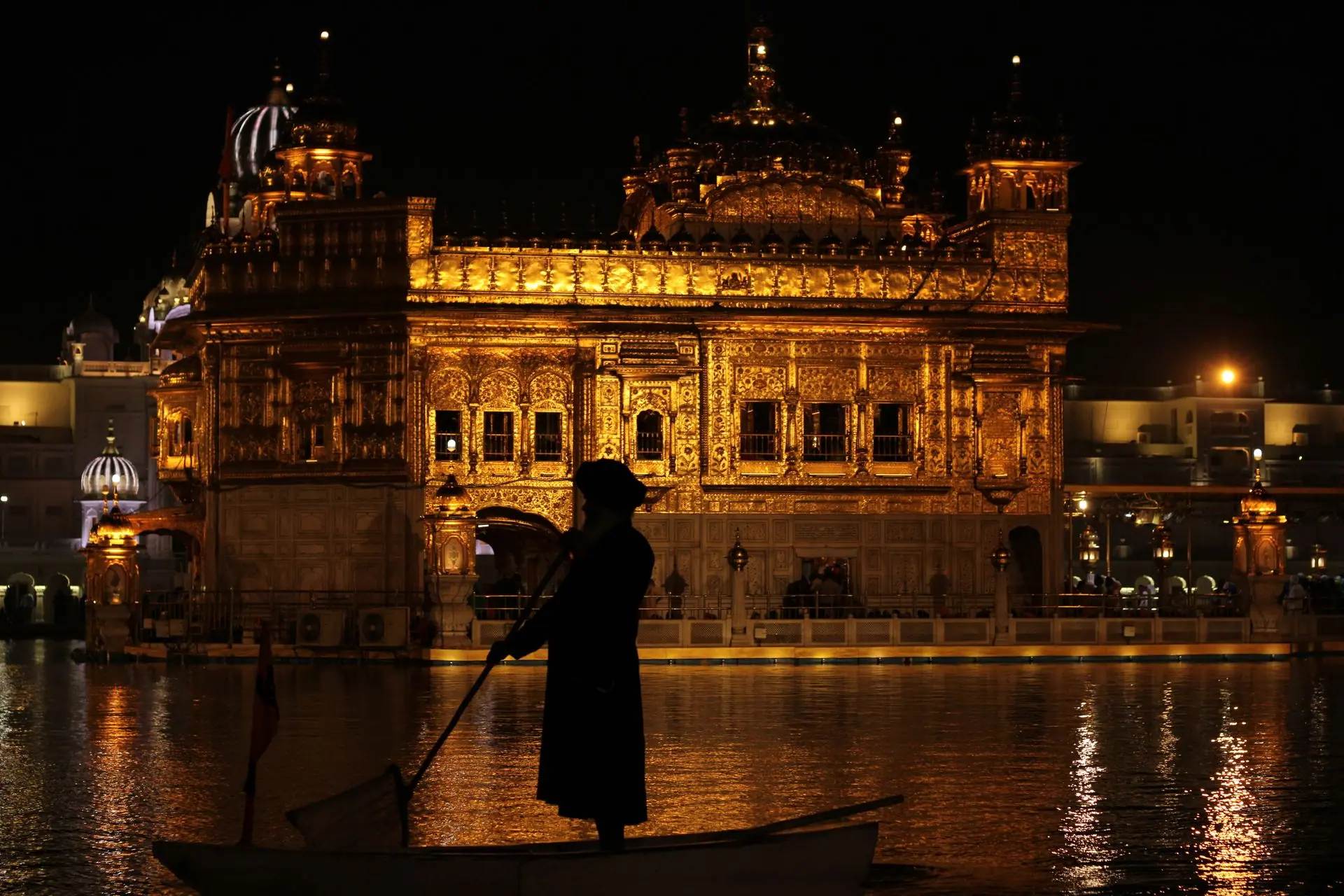
The Golden Temple, also called Sri Harmandir Sahib or Sri Darbar Sahib, is the central place of worship of the Sikhs. Guru Arjan, the fifth Guru, designed it and had it opened on four sides, so that anyone could enter without distinction of caste, creed, sex or religion. It stands in the Amrit Sarovar; Maharaja Ranjit Singh renovated it with marble and copper in 1809 and gave gold for its sanctum in 1830, which is how it got its popular name. Punjab Tourism says nearly one lakh visitors reach it each day. Remove your shoes and cover your head; the queue for the inner sanctum can be long.

Akal Takht, the Interpretation Centre and the Central Sikh Museum

The Akal Takht stands directly in front of the Golden Temple and is the first and primary seat of Sikh temporal and spiritual authority; Punjab Tourism dates it to the early 17th century but gives both 1606 and 1609, so we give no year. Underground in the complex, the Interpretation Centre has four galleries, each showing 15-minute videos, with free English-translation headsets, and Punjab Tourism lists it as open from 9 am to 4 pm. The Central Sikh Museum, also inside the complex, holds paintings, artefacts and manuscripts on Sikh history; its hours are listed only as "check locally".

The langar

The langar hall at the Golden Temple is a multi-storeyed building that the district administration says stays open for 24 hours, where everyone sits in rows, the pangat, and eats the same food regardless of faith. Punjab Tourism says it serves tens of thousands of people every day without interruption, and Incredible India says the food is vegetarian and free. Incredible India says volunteers prepare and serve the meals. Eating there is a normal part of a visit, not an extra.

Baba Atal Sahib

Gurudwara Baba Atal Sahib is a nine-storeyed tower in the Golden Temple precinct, built in memory of Atal Rai, a son of Guru Hargobind who died aged nine; each storey stands for a year of his life. Punjab Tourism says its open terrace gives a view over the city and the temple complex, and that it is open throughout the day.

Jallianwala Bagh

A short distance from the Golden Temple, this national monument marks the shooting of 13 April 1919, when troops fired, on the orders of Brigadier-General Reginald Dyer, on a crowd that had gathered on Baisakhi Day to protest against the Rowlatt Act. Bullet marks are still visible on the walls, and the well in the garden, into which many people jumped to escape the firing, remains. A Martyrs' Gallery records the events. Official listings give different hours; it is open daily from early morning into the evening.

Partition Museum

The Town Hall houses the world's first museum devoted entirely to the Partition of 1947, in 14 galleries of photographs, newspaper clippings, letters and the donated belongings of people who lived through it. Visitors can leave a message in the Gallery of Hope. Punjab Tourism and Incredible India both give opening hours of 10 am to 6 pm, and both say the museum is closed on Mondays.

Heritage Street and the Heritage Walk

Heritage Street, about a kilometre long, runs from the Town Hall to Sri Harmandir Sahib, with pink-toned building fronts, statues, lamp-posts and fountains, a large statue of Maharaja Ranjit Singh and a marble memorial to those who died at Jallianwala Bagh. Live Gurbani kirtan from the temple plays on a large LED screen, and Punjab Tourism says it looks best lit up in the evening. The Amritsar Heritage Walk follows narrow lanes of katras, havelis and bungas for about 45 minutes between the Town Hall and the temple; Punjab Tourism suggests the morning or early evening.

Gobindgarh Fort

Gujjar Singh Bhangi built the fort in the 1760s and Maharaja Ranjit Singh rebuilt it in the early 19th century; the Indian Army held it until it was restored and opened to the public. Today it has exhibitions on Sikh martial history and Ranjit Singh's treasury, the Tosha Khana coin museum, live shows, a projection-mapping show in Punjabi and English called Whispering Walls, and Sher-e-Punjab, a 15-minute 7D film. Punjab Tourism lists it as open daily from 10 am to 10 pm and advises visiting in the evening to see all the shows.

Durgiana Temple

About 1.5 km from the Golden Temple, near Lohgarh Gate, the Durgiana Temple is dedicated to the Hindu goddess and also called the Laxmi Narayan Temple. It was originally built in the 16th century and rebuilt in 1921 in the architectural style of the Golden Temple. Punjab Tourism lists it as open from 5.15 am to 1 pm and from 3 pm to 9 pm.

Attari–Wagah border ceremony

The Retreat Ceremony at the Attari–Wagah border is a flag-lowering ceremony held every evening, with Border Security Force soldiers performing drills before large crowds. Attari is about 30 km from Amritsar: Punjab Tourism gives 28 km and the district administration 32 km. The Border Security Force changes the start time with the season, so check it on the day, and arrive at least 45 minutes early for a seat with a clear view.

Ram Tirath

About 11 km from the Golden Temple on the Amritsar–Lopoke road, Bhagwan Valmiki Tirath Sthal is believed to be the ashram of Valmiki, where he wrote the Ramayana, and the birthplace of Luv and Kush. A temple with a gold-plated statue of Valmiki stands in the middle of a sarovar, with a parikrama of nearly two kilometres around it. Punjab Tourism lists it as open from 6 am to 10 pm, and a four-day fair takes place here on the November full moon.

Punjab State War Heroes' Memorial and Museum

About 11 km from the Golden Temple, the memorial has a 45-metre-long sword rising above its forecourt with four lion heads at the base. The museum covers wars from the time of Maharaja Ranjit Singh to the Kargil War of 1999, and has a 7D theatre showing the battles of 1965 and 1971. Punjab Tourism lists summer hours of 9.30 am to 6.30 pm and winter hours of 10 am to 5.30 pm.

Sadda Pind

About 8 km from the Golden Temple, Sadda Pind, "Our Village", is a living museum of Punjabi culture on 12 acres, with folk dances, handicrafts, songs, stories and food. Punjab Tourism says it gives a hands-on experience of rural life in Punjab, lists it as open from 10.30 am to 10 pm, and notes that it has 20 guest rooms.

Khalsa College and Ram Bagh

Khalsa College, built in 1892 by Bhai Ram Singh, has a 300-acre campus about 5 km from the temple; Punjab Tourism says it can be seen from outside at all times and has often been a film location. Ram Bagh Palace, Maharaja Ranjit Singh's summer palace, is now a museum of his paintings, miniatures, coins and belongings, with replicas of his golden throne and the Kohinoor; Punjab Tourism gives no hours, so check locally.

Hall Bazaar and Lawrence Road

Punjab Tourism names these two markets for phulkari embroidery, Punjabi juttis, traditional textiles, papad, wadiyan, masalas and jewellery. Its state FAQ also lists Choora Bazaar and Papad Bazaar among Amritsar's best-known bazaars, so these four are the places to look for local crafts, textiles and food in the old city.

Day trips from Amritsar

  • Harike Wetland: the largest wetland in northern India, where the Beas and Sutlej meet, a Ramsar site with resident and migratory birds, best in the early morning.
  • Jandiala Guru: the Thatheras, the craftsmen who hammer brass and copper sheets into utensils, whose craft UNESCO inscribed on its Representative List of the Intangible Cultural Heritage of Humanity in 2014. Punjab Tourism says visitors can watch them work and buy directly, and that workshop hours vary.
  • Kapurthala and Sultanpur Lodhi: Kapurthala is about 75 km away, and Sultanpur Lodhi is in the same district; both are covered in our Punjab guide.

Things to do in Amritsar

Eat Amritsari kulcha and chhole bhature, walk Heritage Street in the late evening when it is lit, and end a day at the border ceremony or Gobindgarh Fort's evening shows. For guided visits and trips that include Amritsar, see our Amritsar tours and experiences and Amritsar tour packages. Our Golden Temple, Amritsar tour is a private guide and vehicle with a briefing on dress code and etiquette, with time to eat at the langar. The 10 Days Delhi Agra Jaipur with Golden Temple Tour adds flights between Delhi and Amritsar to the Golden Triangle, a full day at the Golden Temple complex including the langar, the evening Wagah ceremony, and Jallianwala Bagh and the Partition Museum.

Best time to visit Amritsar

Punjab Tourism gives October to March. The IMD's 1991–2020 table for Chandigarh, whose Meteorological Centre also forecasts for Punjab, puts average daily maximums at 18.2°C in January, 38.6°C in May and 37.7°C in June, with 275.6 mm of rain in July and 273.0 mm in August. In Amritsar itself, recent May and June maximums have topped 45°C, and January minimums in recent years have been between about 1°C and 3°C. Winter fog over Punjab can take Amritsar's visibility to zero on some mornings and affect airports, highways and railway routes. Festivals fill the calendar: Lohri, which marks the end of winter, Baisakhi in April, with large gatherings at the Golden Temple and the Akal Takht, the Ram Tirath fair in November, and Diwali, when the Golden Temple and the old city are lit with thousands of lights.

How to reach Amritsar

  • By air: Sri Guru Ram Dass Jee International Airport (ATQ) has domestic and international flights; the Airports Authority of India puts it about 11 km from the centre of the city, and the district administration puts it 13 km from the Golden Temple.
  • By train: Amritsar Central (ASR) is on Northern Railway, about 2 km from the Golden Temple, with direct services to Delhi, Chandigarh and Mumbai. Indian Railways lists Amritsar Shatabdi trains numbered 12013/12014 and 12031/12032. See our guide to trains and IRCTC for foreigners.
  • By road: Delhi Tourism's distance chart gives 447 km from Delhi. The main bus stand has services to the state's cities.
  • In the city: auto-rickshaws, cycle-rickshaws and a Hop-on Hop-off tourist bus, whose schedule you should check locally.

How many days in Amritsar

Two days covers Amritsar. On the first, visit the Golden Temple early, when the district administration says it is less crowded, then walk Heritage Street to Jallianwala Bagh and the Partition Museum (not on a Monday), and spend the evening at Gobindgarh Fort. On the second, see the Durgiana Temple, then choose between Ram Tirath, the War Heroes' Memorial and Sadda Pind, and go to Attari for the evening ceremony. One day is possible but tight, with the border ceremony as the part to drop. A third day suits Harike, Jandiala Guru, or Kapurthala.

Where to stay and getting around

The Shiromani Gurdwara Parbandhak Committee (SGPC) lists six niwas, or pilgrim lodgings, kept up by the Sri Darbar Sahib authorities. Their reception counters work around the clock, the New Akal Rest House has rooms reserved for foreign tourists, and bookings are first come, first served, subject to availability. Sadda Pind has 20 guest rooms, and Punjab Tourism lists farmstays. We have not verified individual hotels for this guide.

Why book with Experience My India

  • Government-approved operator

    Approved by the Ministry of Tourism, Government of India

  • 500+ vetted local guides

    35+ destination specialists plan every trip by hand.

  • Human help, every day

    Mon–Sun, 9:00 AM – 9:00 PM IST · +91 73022 65809

  • No payment until you approve

    You receive a written quote first; nothing is charged to start planning.

Frequently asked questions

Is the Golden Temple open at night?

Punjab Tourism lists the complex as open through the day and night, and the langar hall stays open round the clock. The sanctum itself follows the SGPC's daily routine: its doors open between about 2 and 3 am depending on the season, and between about 9.45 and 10.45 pm Guru Granth Sahib is carried back to the Akal Takht for the night. Listings of visiting hours vary, so check at the gate.

Can non-Sikhs eat at the langar?

Yes. The district administration says the langar gives free food to every visitor regardless of colour, creed, caste or gender, and its hall stays open for 24 hours. Everyone sits in rows and eats the same vegetarian meal. Cover your head and remove your shoes before entering the complex.

Which museums are inside the Golden Temple complex?

The Interpretation Centre is an underground multimedia museum with four galleries, each showing 15-minute videos, free English-translation headsets and, per Punjab Tourism, hours of 9 am to 4 pm. The Central Sikh Museum holds paintings, artefacts and manuscripts on Sikh history and the Gurus; Punjab Tourism gives no hours and says to check locally.

How do you get to the Attari–Wagah border ceremony?

Attari is about 30 km from Amritsar. We found no official public-transport timings, so arrange a taxi or a guided trip. The Border Security Force holds the flag-lowering ceremony every evening before sunset and changes the start time with the season, so confirm it on the day and arrive at least 45 minutes early for a seat.

What should you eat in Amritsar?

Punjab Tourism lists Amritsari kulcha, chhole bhature, dal makhani and makki ki roti with sarson ka saag among the vegetarian dishes, and Amritsari tandoori chicken and Amritsari fish among the non-vegetarian ones. Peda-lassi, patisa, pinni, jalebi and phirni are among the sweets. The langar serves a free vegetarian meal to all visitors.

How do you walk from the Town Hall to the Golden Temple?

Heritage Street runs about a kilometre from the Town Hall to Sri Harmandir Sahib, lined with pink-toned façades, statues and fountains, and lit in the evening, with live Gurbani kirtan shown on a large LED screen. The Amritsar Heritage Walk takes narrow lanes between the same points in about 45 minutes, best in the morning or early evening.

How far is Amritsar from Delhi, and how do you get there?

Delhi Tourism's distance chart gives 447 km by road. Amritsar Central railway station has direct services to Delhi, and Indian Railways lists Amritsar Shatabdi trains 12013/12014 and 12031/12032, though we could not read an official journey time, so check IRCTC. The city's airport has domestic and international flights.

Is Amritsar worth visiting?

Yes, if you want a living pilgrimage site, a place that records the history of 1919 and 1947, and good food. Punjab Tourism says nearly one lakh people visit the Golden Temple every day, and the city adds Jallianwala Bagh, the world's first Partition Museum and its bazaars. It is a poor fit if you dislike queues, since the line for the inner sanctum can be long.

How many days are enough for Amritsar?

Two days cover the Golden Temple, Jallianwala Bagh, the Partition Museum, Heritage Street, Gobindgarh Fort and the border ceremony. With one day, keep to the temple, Jallianwala Bagh and Heritage Street, and add the ceremony only if you have time. A third day suits Harike, Jandiala Guru, or Kapurthala and Sultanpur Lodhi.

Tour packages in Amritsar

See all
Customer reviews

Experience My India is rated 4.3 on Tripadvisor. We publish guest reviews after each trip.

Read our reviews

Plan a trip

Tailor-made quote from a specialist