
1 tour package in Ajanta & Ellora Caves
Ajanta and Ellora caves from Aurangabad 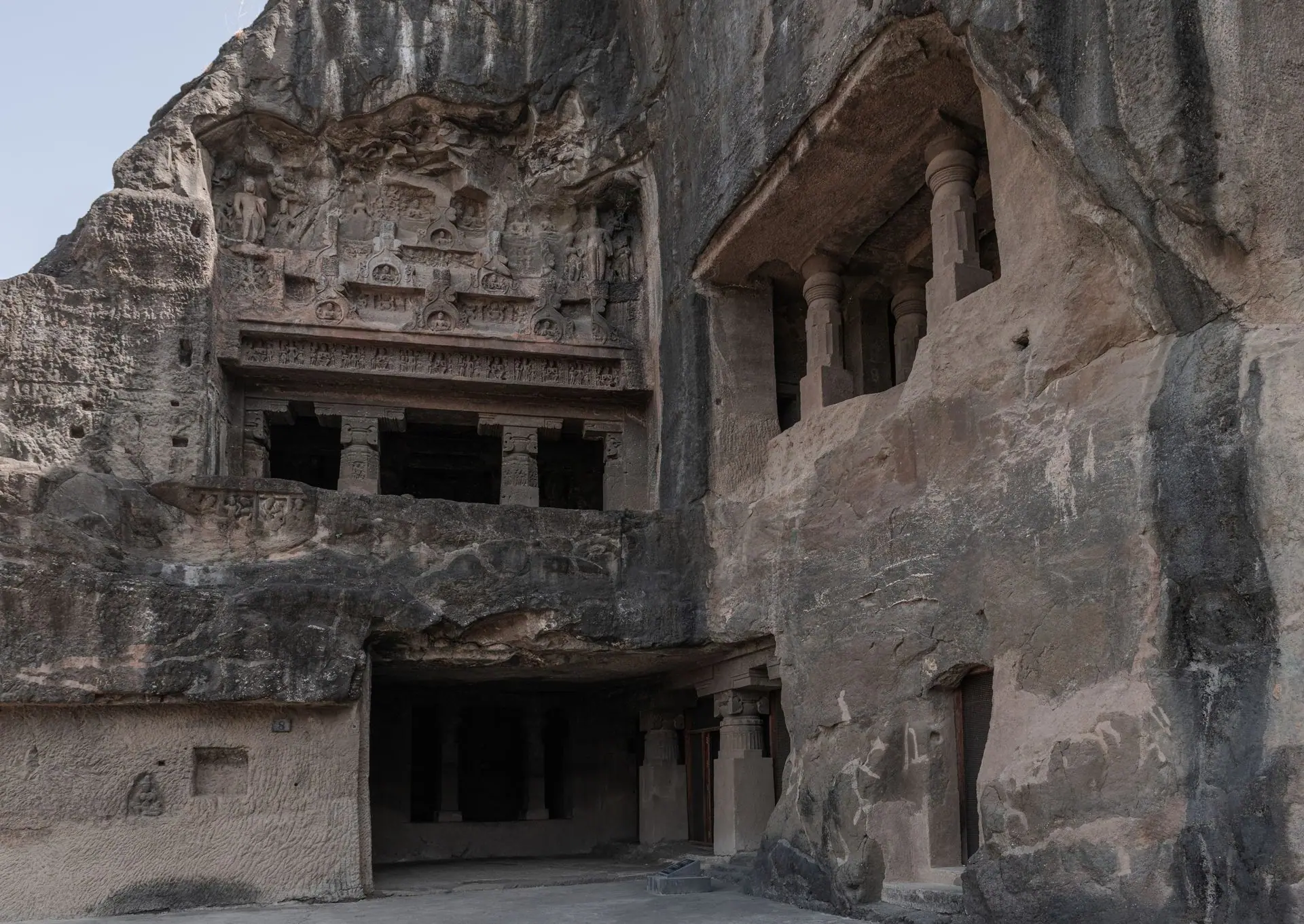
Tour package
Ajanta and Ellora caves from Aurangabad
Free cancellation
Price on request
View details
Tour packages in other states
See all
Uttar Pradesh
19 tour packages
Rajasthan
18 tour packages
Across India
8 tour packages
Uttarakhand
6 tour packages
Delhi
4 tour packages
Ladakh
4 tour packages
Goa
3 tour packages
Himachal Pradesh
3 tour packages
Karnataka
3 tour packages
Kashmir
3 tour packages
Kerala
3 tour packages
Tamil Nadu
3 tour packages
Punjab
2 tour packages
Andhra Pradesh
1 tour package
Bihar
1 tour package
Madhya Pradesh
1 tour package
Maharashtra
1 tour package
Odisha
1 tour package
Frequently asked questions
Should we see Ellora or Ajanta first?
Our package usually starts with Ellora, about 30 km from the city, and gives the second day to Ajanta, the longer drive. The closing days decide the rest: Ajanta shuts on Mondays and Ellora on Tuesdays, so if your first sightseeing day is a Monday, Ellora must come first. Ellora opens from sunrise to sunset and Ajanta from 9 am to 5 pm, so an early start on the Ajanta day leaves more time at the caves.
Which caves at Ajanta have the finest paintings?
The Archaeological Survey of India points to Caves 1, 2, 16 and 17, painted from around the 5th to 6th centuries AD in the time of the Vakataka kings, with scenes from the Jataka tales and the life of the Buddha. The oldest surviving fragments, from the 2nd century BC, are in Caves 9 and 10. Strictly, they are not frescoes: the colours were bound with glue rather than laid into wet lime plaster.
Are there audio guides at Ajanta?
Yes. The Archaeological Survey of India offers audio guides at Ajanta in English, French, Spanish, German, Italian, Hindi and Bangla, from near the ticket counter. On our package you also have a private guide for both days, who can answer your questions, slow down where you want to linger, and point out details in the paintings and carvings that a recorded commentary passes by.
How fit do you need to be for Ajanta and Ellora?
Reasonably. Both sites involve a good deal of walking on stone, and at Ajanta there is a climb up to the cave entrances, which are cut into a cliff nearly 76 m high above the Waghora stream. Ellora's caves are spread along a rock face nearly 2 km long. Comfortable shoes with a good grip help, and the private car keeps the rest of each day easy. Tell your specialist about any mobility needs before you book.
Can we visit Ajanta and Ellora in the monsoon?
Yes, if you accept some rain. The Archaeological Survey of India says Ellora is at its best in the monsoon, when every stream runs and the hills turn green. But IMD's averages show June to September bringing over 80 per cent of the city's yearly rain, and the long drive to Ajanta is harder in the wet. If you come between mid-June and early October, allow slack in the plan; for dry, mild days, aim for October or November to March.
What else can we see near Ellora?
Maharashtra Tourism lists several neighbours. Daulatabad Fort, the 12th-century hill fort once called Devagiri, is a short distance away, with its 30-metre Chand Minar tower. The Ghrishneshwar temple, close to the caves, is one of the twelve Jyotirlingas, Shiva's most revered shrines. In and near Chhatrapati Sambhajinagar are the Bibi Ka Maqbara, a Mughal mausoleum often compared with the Taj Mahal, and the city's own Buddhist caves of the 6th and 7th centuries. A third day fits them in.
Can we combine Ajanta and Ellora with Mumbai?
Yes, as one tailor-made trip. Spend a day or two in Mumbai, with our street food tour and perhaps the Elephanta Caves, then take a direct train or a flight to Chhatrapati Sambhajinagar for the two cave days. Maharashtra Tourism suggests three to five days for Mumbai itself if you want to see it properly. Hotels, transfers and every day's plan go into one written quote before you pay anything.
About Ajanta & Ellora Caves Tour Packages
Our Ajanta Ellora tour package is for travellers who want both World Heritage cave sites seen properly: a full day at Ellora's Buddhist, Hindu and Jain caves, including the Kailasa temple, and another among Ajanta's painted Buddhist caves, with a private guide and car from Chhatrapati Sambhajinagar, formerly Aurangabad. The two days are set around each site's weekly closing day and quoted in writing before you pay.
Reviewed by Experience My India Editorial Team · Updated 21 Oct 2026
Why go to Ajanta and Ellora
Two of India's best-known rock-cut sites lie north of Chhatrapati Sambhajinagar, and both have been World Heritage Sites since 1983. At Ajanta, 30 caves were cut into a horseshoe-shaped cliff nearly 76 m high above the Waghora stream between about the 2nd century BC and the 6th century AD; their Buddhist paintings are, for the Archaeological Survey of India (ASI), among the finest surviving examples of Indian art. Ellora is a different experience: 34 caves of three faiths, Buddhist, Hindu and Jain, along a rock face nearly 2 km long. Among them is the Kailasa (Cave 16), which the ASI calls the largest single monolithic excavation in the world. Our Ajanta and Ellora travel guide has more.
How many days to give Ajanta and Ellora
Two full days, plus your journey to Chhatrapati Sambhajinagar. Our Ajanta and Ellora caves from Aurangabad spends the first day at Ellora, the nearer site, and the second at Ajanta, the longer drive. Both in one very long day is possible, but you would hurry through each. Ajanta is closed on Mondays and Ellora on Tuesdays, so we set the order around your dates: Ellora on a Monday and Ajanta on a Tuesday works, Ajanta on a Monday does not. A third day adds Daulatabad Fort, the Ghrishneshwar temple or the city's Bibi Ka Maqbara.
When to go
Maharashtra Tourism recommends November to March for Ajanta, at about 12 to 30°C, and October to March for Ellora, at about 15 to 30°C. IMD's averages for the city's Chikalthana weather station show why: April and May average highs close to 39°C, and June to September bring about 650 mm of the 790 mm the city gets in a year. The monsoon normally arrives around 13 June and withdraws around 9 October. The ASI notes that Ellora is at its greenest in the rains, but the long road to Ajanta is harder going then. December and January mornings average about 12°C, so bring a layer for early starts.
How to reach Ajanta and Ellora
Fly or take the train to Chhatrapati Sambhajinagar, the city long known as Aurangabad: its airport and railway station now carry the new name, and direct trains from Mumbai's CSMT include a Vande Bharat express. Both cave sites lie north of the city. The ASI puts Ellora 30 km north-north-west and Ajanta 107 km north; by road, Maharashtra Tourism gives about 31 km and 103 km. Once you arrive, the package's private car and driver take over: your onward transfers and both days of sightseeing are arranged for you. Our India train guide for foreign visitors explains booking the journey.
What our Ajanta Ellora tour package includes
A private guide and a private vehicle for both days, with a driver throughout, and transfers from your arrival. A guide matters at these sites: the murals, sculpture and carved temples make far more sense with someone who can read their stories and their history to you. Flights into India, visa fees, monument tickets and personal spending are not included. A hotel in Chhatrapati Sambhajinagar is not part of the package as listed, so your specialist adds one to the written quote, which sets out every day before you pay anything.
Who our Ajanta Ellora tour package suits
Travellers who come for art and architecture and can give the caves at least two days. It is less suited to a one-day stopover, which forces a choice between the sites or a rush through both. Expect a lot of walking at both sites and, at Ajanta, a climb to the cave entrances, so wear comfortable shoes; photography rules differ from cave to cave, and your guide explains them on the day. Starting in Mumbai, add our Mumbai street food tour before you head inland; for the rest of the state, see Maharashtra tour packages.
Plan a trip
Tailor-made quote from a specialist