Skip to content

Khajuraho Travel Guide: Temple Groups, Museums and Planning

Khajuraho, in Madhya Pradesh's Chhatarpur district, was the seat of the Chandela kings, and its carved Hindu and Jain temples are a UNESCO World Heritage Site. The places to visit in Khajuraho start with the three temple groups, Western, Eastern and Southern, led by the Kandariya Mahadeva, then the museums, the evening sound-and-light show and Raneh Falls. Come between October and March.

By Experience My India Editorial Team · Reviewed by Experience My India Editorial Team · Updated 1 Sept 2026

See all 1 tour or experience in Khajuraho →

Government-approved operatorApproved by the Ministry of Tourism, Government of India

Places to visit in Khajuraho

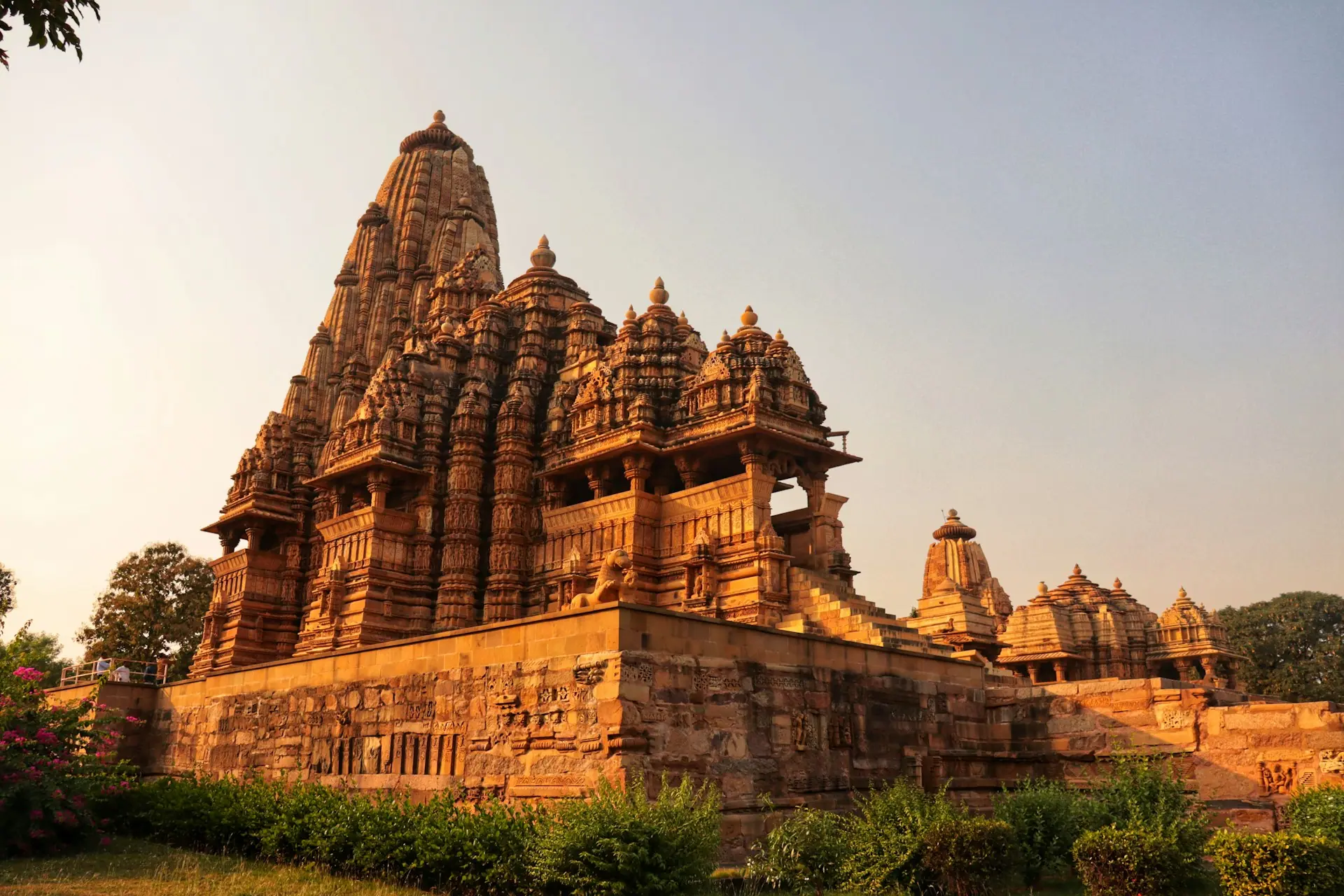
Khajuraho was the principal seat of the Chandela rulers, and MP Tourism dates most of its temples to between 950 and 1050. They stand in western, eastern and southern clusters spread over about 6 square kilometres around the modern town, and UNESCO's listing counts 23 of them, built of sandstone on high, ornate platforms in the northern Nagara style. The Archaeological Survey of India opens them from sunrise to sunset. Every trip we run here is on our Khajuraho tours and experiences page.

Kandariya Mahadeva Temple

The largest and grandest temple at Khajuraho, in the Archaeological Survey's words, is named for Shiva as Mahadeva and attributed to king Ganda, who reigned from 1017 to 1029. It shows the features UNESCO describes for the whole group at their fullest: a high, ornate platform, and a main spire ringed by smaller spires that each stand for Mount Kailasa. Its outer walls are profusely carved, in UNESCO's word, with gods, celestial women, dancers and musicians. It stands in the Western Group, which MP Tourism says holds about 870 sculptures, so give it time rather than a quick circuit.

Lakshmana and Matangeshwar temples

The Lakshmana temple, dedicated to Vishnu, was built by king Yasovarman, and the Archaeological Survey dates it to AD 954, more than sixty years before the Kandariya Mahadeva. Just to its south, on the north bank of the Shiv Sagar tank, stands the Matangeshwar, a 10th-century Shiva temple that, MP Tourism notes, is still in active worship: devotees walk round its large, polished lingam. It is the place to see worship as it happens, so dress modestly and keep your voice down.

Vishwanatha, Chitragupta and Jagadambi

The rest of the Western Group stands close to the Archaeological Museum. The Archaeological Survey dates the Vishwanatha temple to the reign of king Dhanga, Yasovarman's successor, and places the Jagadambi and Chitragupta temples among the royal temples of the western group; MP Tourism's list adds the Varaha shrine and the Nandi pavilion. In the evening, the sound-and-light show tells the story of the Chandela kings here, in English and in Hindi, as the light picks out the niches of the temple walls.

Chausath Yogini

Built in the 9th century, the Chausath Yogini is, in MP Tourism's words, probably the oldest yogini temple in India and the oldest temple at Khajuraho. Its name means sixty-four, for the cells it once held. With the Brahma and Mahadeva shrines, it is one of three temples here built of granite rather than the fine-grained buff, pink or pale yellow sandstone the Archaeological Survey describes for the rest.

The Eastern Group

Hindu and Jain temples share the Eastern Group. UNESCO's site plans of 1986 show the Vamana, Javari and Brahma temples together and the Jain temples as a cluster of their own. The Archaeological Survey calls the Vamana smaller but elaborately designed, and dates the Jain Parsvanatha to king Dhanga's time; MP Tourism notes that the Parsvanatha is one of a couple of old temples built of honey-coloured sandstone, and lists the Adinatha, Shantinatha and Ghantai beside it. Fewer visitors come this way than to the Western Group.

The Southern Group: Duladeo and Chaturbhuj

Two temples stand in the Southern Group. The Duladeo, also called Kunwar Math, has flying celestials carved on its uppermost spire and finely detailed jewellery on its female figures. The Chaturbhuj is, as MP Tourism points out, the only temple at Khajuraho without a single erotic sculpture, a useful reminder of how small a part such carving plays in the whole site.

The Archaeological Museum and the Jain Museum

The Archaeological Survey's museum, very close to the Western Group, shows sculpture from the site with names and approximate dates, a dancing Ganesha among it, and has a gallery of Jain sculpture. A separate Jain Museum, about 1 km from the bus station, displays sculptures of the 24 Tirthankaras. Either fills an hour in the middle of the day, when the heat makes the open temples hard work.

Adivart Tribal and Folk Art Museum

Adivart rebuilds traditional houses of seven of Madhya Pradesh's tribes, the Gond, Baiga, Bhil, Bharia, Korku, Kol and Saharia, with their utensils, furniture and art. It shows a side of the state that the court art of the temples does not, and fits easily into an afternoon after the Western Group.

Raneh Falls and Pandav Falls

On the Ken river, Raneh Falls lies 20 to 21 km from Khajuraho by MP Tourism's figures, where the river has cut a canyon about 5 km long and 30 metres deep in granite of pink, red and grey. Pandav Falls, on the road between Khajuraho and Panna, drops 30 metres into a pool with caves at its foot that local tradition links to the Mahabharata. Both make a half-day out of town.

Panna National Park

The forest department puts Panna Tiger Reserve's Madla gate 25 km from Khajuraho. It is a park of plateaus, gorges and waterfalls along the Ken river, where MP Tourism lists boat rides as well as safaris, and MP Tourism gives its season as October to June. Permits are sold on the state forest department's booking site. We do not run trips to Panna.

Things to do in Khajuraho

Walk the Western Group with a guide at opening time, stay for the sound-and-light show after dark, and plan a February visit around the Khajuraho Dance Festival, a week of classical dance staged against the Western Group. Our Khajuraho temples tour gives you a private guide and vehicle for a day across all three groups, with help booking entry tickets in advance; the tickets themselves are confirmed on your quote.

Best time to visit Khajuraho

The Ministry of Tourism gives October to March as the best time to visit, when a day on foot between the temple groups is comfortable. IMD publishes no climate summary for Khajuraho itself; for Satna, the nearest city in its series, it puts January days at about 24°C and nights at about 9°C, with fog on some winter mornings, so bring a layer for an early start. Heat builds through April to a May average high of about 42°C, when the temples are best seen early in the morning and late in the afternoon. About 89 per cent of Satna's rain falls in the south-west monsoon, with August the wettest month.

Two festivals are worth timing a trip for. The Khajuraho Dance Festival, held each February for a week at the Western Group, brings classical dancers from across India, with Bharatanatyam, Kathak and Odissi among the forms; book rooms early. Mahashivratri, in February or March, brings three days of celebrations at the Matangeshwar temple. For the rest of the country, see our best time to visit India guide.

How to reach Khajuraho

  • By air: Khajuraho's domestic airport (HJR) lies about 2 km from the temples, but the Chhatarpur district administration notes it has a limited number of flights, so check schedules before you plan around one.
  • By train: Khajuraho station, about 5 km from the town, is linked to a few cities. Mahoba, about 78 km away, is the closest major railhead, and Jhansi Junction, about 175 km away, has trains from Delhi, Mumbai, Chennai, Bengaluru, Kolkata, Indore and Ahmedabad.
  • By road: Buses run to nearby cities such as Jhansi, and private cabs are available. The road from Jhansi passes Orchha, which MP Tourism places between Jhansi and Khajuraho, so the two pair naturally.

Bandhavgarh Tiger Reserve lists Khajuraho's airport as its nearest after Jabalpur's, so the temples and a safari can share one trip; see our Bandhavgarh travel guide.

How many days in Khajuraho

A full day sees all three temple groups at a steady pace: the Western Group first, walked slowly, then the Eastern and Southern Groups in the afternoon, which is how our temples tour runs. The Western Group alone needs half a day. Because flights and trains are few, plan at least one night, which also leaves the evening for the sound-and-light show. A second day adds Raneh Falls, Pandav Falls or Panna, or the museums at an easy pace. Our Khajuraho tour packages list every route that stays in the town, and for Orchha, Sanchi or the tiger reserves, read our Madhya Pradesh travel guide.

Tips for visiting the temples

  • Start early: the Archaeological Survey opens the temples at sunrise, and the first hours are the coolest, with low light that shows the depth of the carving.
  • Dress for temples: some temples, the Matangeshwar above all, are still in worship. Cover shoulders and knees, and wear shoes that slip off easily, as some platforms and steps are climbed barefoot.
  • Photographs: photography outdoors is generally fine; ask before photographing inside a shrine in active use, and follow any signs at the gates.
  • Take a guide: with about 870 sculptures on the Western Group alone, a guide who reads the bands of figures turns a walk into an explanation. The Archaeological Survey sets the entry fee, so check it before you go; we never quote it.
  • Getting between groups: the clusters are spread around the town, so a car makes it easy to link the Eastern and Southern Groups in the heat.

Why book with Experience My India

  • Government-approved operator

    Approved by the Ministry of Tourism, Government of India

  • 500+ vetted local guides

    35+ destination specialists plan every trip by hand.

  • Human help, every day

    Mon–Sun, 9:00 AM – 9:00 PM IST · +91 73022 65809

  • No payment until you approve

    You receive a written quote first; nothing is charged to start planning.

Frequently asked questions

Who built the Khajuraho temples?

The Chandela kings, who made Khajuraho their principal seat and ruled the region in the 10th and 11th centuries. The Archaeological Survey dates the Lakshmana temple to AD 954 under Yasovarman, the Vishwanatha and Parsvanatha to the reign of his successor Dhanga, and the Kandariya Mahadeva to king Ganda, who reigned from 1017 to 1029. MP Tourism puts most of the building between 950 and 1050.

Are the Khajuraho temples Hindu or Jain?

Both. The Western Group's temples are Hindu, among them temples to Shiva and Vishnu, while the Eastern Group holds a cluster of Jain temples, the Parsvanatha, Adinatha, Shantinatha and Ghantai, beside the Vamana, Javari and Brahma temples. The Jain Museum, about 1 km from the bus station, shows sculptures of the 24 Tirthankaras, and the Archaeological Museum has a Jain gallery.

Are all of Khajuraho's carvings erotic?

No. MP Tourism puts the erotic sculptures at only about 10 per cent of the whole, and one temple, the Chaturbhuj in the Southern Group, has none at all. UNESCO describes the carving as covering sacred and secular themes alike: deities, dancers and musicians, teachers with their disciples, and couples. A guide helps you see the whole programme of the walls rather than a few famous panels.

What can you see in Khajuraho in one day?

Start at sunrise in the Western Group with the Kandariya Mahadeva, Lakshmana and Vishwanatha temples, and look in at the Matangeshwar next door. After the Archaeological Museum and lunch, drive to the Eastern Group's Jain temples and the Vamana and Javari, then to the Duladeo and Chaturbhuj in the Southern Group. Return to the Western Group for the sound-and-light show after dark.

Can you fly to Khajuraho?

Yes. Khajuraho has its own domestic airport, about 2 km from the temples, but the Chhatarpur district administration notes that it has a limited number of flights, so check the schedule for your dates before building a trip around one. If there is no convenient flight, Jhansi Junction, about 175 km away, has trains from Delhi, Mumbai and other large cities, and Orchha lies on the road between the two.

Does Khajuraho have a railway station?

Yes. Khajuraho station lies about 5 km from the town and, in MP Tourism's words, links it to a few cities. The closest major railhead is Mahoba, about 78 km away. You can also come by train to Jhansi Junction, about 175 km away, which has trains from Delhi, Mumbai, Chennai, Bengaluru, Kolkata and other cities, and drive on by way of Orchha.

Is Khajuraho suitable for families?

Yes, with a little planning. Keep temple walks to the cooler early morning, and break the day with the museums, where Adivart's rebuilt village houses make a change from temples. The sound-and-light show suits all ages. Most of the carving shows gods, dancers, musicians and scenes of daily life, and a guide can pace the explanation to the ages in your group.

Tour packages in Khajuraho

See all
Customer reviews

Experience My India is rated 4.3 on Tripadvisor. We publish guest reviews after each trip.

Read our reviews

Plan a trip

Tailor-made quote from a specialist