Skip to content

Tirupati Travel Guide: Tirumala, Its Temples and Planning Your Darshan

Tirupati is the Andhra Pradesh town at the foot of the Tirumala hills, and most visitors come for darshan at the Sri Venkateswara Temple in the hills above it. The main places to visit in Tirupati are that temple, with its tank, museum and natural rock arch, and the Govindaraja Swamy, Kapileswara and Padmavathi temples below. Allow two days, and book darshan only through TTD's website.

By Experience My India Editorial Team · Reviewed by Experience My India Editorial Team

See all 1 tour or experience in Tirupati →

Government-approved operatorApproved by the Ministry of Tourism, Government of India

Places to visit in Tirupati

The sights fall into two groups: those on Tirumala, the temple town in the Seshachalam hills, and those in and around Tirupati below, where the railway station, the older town temples, a fort and a zoo are found.

Sri Venkateswara Temple, Tirumala

The temple of Lord Venkateswara, a form of Vishnu, stands on Venkatadri, one of the seven peaks of the Seshachalam range, and is run by the Tirumala Tirupati Devasthanams (TTD). AP Tourism counts about 1,150 inscriptions on its walls in Tamil, Telugu and Kannada, left by Pallava, Chola, Pandya and Vijayanagara patrons. There are two everyday routes to darshan: the free Sarva Darshan, entered through the Vaikuntam Queue Complex, where TTD serves free meals, milk, tea and coffee to those waiting, and the paid Special Entry Darshan, booked in advance online.

Swami Pushkarini and the Sri Bhu Varaha Swamy Temple

Beside the main shrine lies Swami Pushkarini, the temple tank, and on its bank the temple of Sri Bhu Varaha Swamy, Vishnu in his boar form. In TTD's telling of the legend, Varaha gave Venkateswara the land for his shrine and was promised the first darshan and the first food offering in return, so the trust asks pilgrims to bathe in the tank and pray to Varaha before going on to the main temple. TTD gives its hours as 5.30 am to noon and 5 pm to 9 pm every day.

Akasa Ganga, Papavinasanam and Silathoranam

The hill holds sacred springs and one geological landmark. Akasa Ganga and Papavinasanam, reached by a road running north-east from the temple town, are theerthams where TTD encourages pilgrims to bathe. To the north-west is Silathoranam, a natural rock arch that the Geological Survey of India protects as a national geological monument; the arch and the rocks of the Tirumala hills are also on India's tentative list for UNESCO World Heritage status.

Sri Venkateswara Museum, Tirumala

TTD's museum on the hill, opposite the Vaikuntam Queue Complex, keeps more than 6,000 objects: the vahanas on which the deity rides in festival processions, the copper plates of Annamayya's songs, stone sculpture from the 8th to the 19th century and copies of more than a thousand of the temple's inscriptions. It fills the hours before or after a darshan slot well. TTD lists it as open every day from 8 am to 8 pm, with no entry charge.

Sri Govindaraja Swamy Temple

In the centre of Tirupati, about a kilometre from the railway station, the Govindaraja Swamy temple was consecrated by the Vaishnava teacher Ramanujacharya in 1130, according to TTD, and the town below the hill grew up around it. Its seven-storeyed outer gopuram, crowned by eleven kalasas, dates from the 14th or 15th century. TTD's museum of temple architecture, also free, stands nearby, and the temple usually opens at 5 am and closes at 9 pm.

Sri Kapileswara Swamy Temple

A Shiva temple at the foot of the hills, about 4 km from the railway station, Kapileswara stands at the mouth of a cave in a sheer rock face, where a mountain stream falls straight into the temple tank, Kapila Theertham. A large stone Nandi sits at the entrance. TTD, which runs the temple, records the belief that every holy spring of the three worlds flows into this tank on the full moon of the month of Karthika.

Sri Padmavathi Ammavari Temple, Tiruchanur

Tiruchanur, about 5 km from Tirupati, is the home of Goddess Padmavathi, Venkateswara's consort. Its other name, Alarmelmangapuram, comes from the legend of the goddess appearing on a golden lotus in the temple tank, Padma Sarovaram. TTD runs the temple, whose compound also holds older shrines, among them one to Krishna that TTD dates to about 1221, and a small tonsure hall; a Suryanarayana temple faces the tank.

Sri Kalyana Venkateswara Swamy Temple, Srinivasa Mangapuram

About 12 km west of Tirupati, this temple marks the place where, by legend, Venkateswara and Padmavathi spent six months after their wedding, at the hermitage of the sage Agastya. The temple is under the control of the Archaeological Survey of India and has been maintained by TTD since 1967. Newly married couples come here to pray, and TTD records the belief that those unable to reach Tirumala receive the same blessing here.

Chandragiri Fort

For a change from temples, Chandragiri Fort stands beside the Swarnamukhi river. AP Tourism records that it became a seat of the Vijayanagara kings after they lost Hampi in the battle of Talikota in 1565. In the lower fort, the three-storeyed Raja Mahal, crowned with towers like a temple's, is now a museum of arms, sculpture and coins. AP Tourism notes that the fort is closed on Fridays and lists an evening sound and light show in Telugu and English.

Sri Venkateswara Zoological Park and the Regional Science Centre

Two stops at the foot of the hills make a change for children. The Sri Venkateswara Zoological Park, opened in 1987 and run by the Andhra Pradesh Forest Department, is laid out on a mythological theme; its own website gives opening hours of 8.30 am to 5 pm and says it closes every Tuesday. The Regional Science Centre on the Alipiri–Zoo Park Road, part of the National Council of Science Museums, has six galleries, a 3D theatre and a Taramandal.

Talakona waterfall

About 40 km from Tirupati, inside the Sri Venkateswara National Park, Talakona falls some 270 feet; both AP Tourism and the district administration call it the highest waterfall in Andhra Pradesh. Cars stop at a parking area beyond the Siddheswara Swamy temple, and the falls are about a 15-minute walk from there. AP Tourism recommends September to January, and APSRTC runs buses from Tirupati's bus station.

Srikalahasti

The Kalahastiswara temple at Srikalahasti, on the Swarnamukhi river, is one of the five Shiva temples that stand for the elements, its linga worshipped as air. AP Tourism notes the town's other name, Dakshina Kasi, and the devotees who travel far for the Rahu Ketu puja, and puts it 29 km from Tirupati airport. The town also gives its name to Srikalahasthi Kalamkari, a textile craft registered as a Geographical Indication.

Things to do in Tirupati

Climbing the hill on foot is the oldest way to arrive. TTD keeps both stone stairways, from Alipiri and from Srivari Mettu, supplied with drinking water, toilets, shelters, canteens and round-the-clock medical help, and carries walkers' luggage to the top free of charge. Many who start at Alipiri first pray at the Srivari Padala Mandapam there, carrying the deity's sandals on their heads, as TTD describes.

On the hill, much of the day follows the rituals. Tonsure is a vow many pilgrims keep at TTD's Kalyanakatta halls, which work in shifts through the day and night. The laddu handed out as prasadam is protected as the Tirupathi Laddu Geographical Indication. TTD's Matrusri Tarigonda Vengamamba Annaprasadam Complex serves free meals: breakfast from 9 am, lunch from 10.30 am to 4 pm and dinner from 5 pm to 10.30 pm.

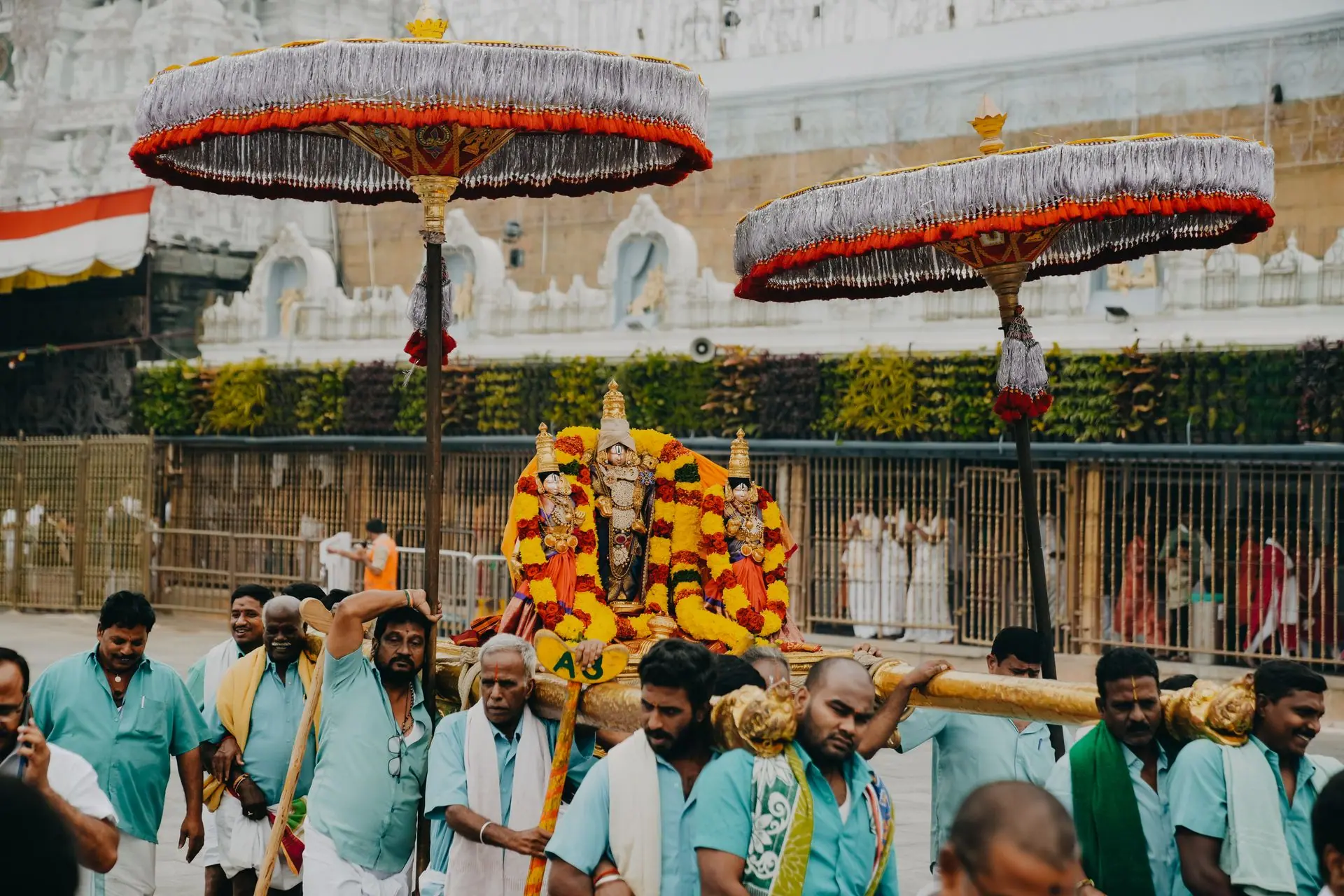
If your dates allow, watch a vahana seva. During the Brahmotsavam the processional deity is carried round the streets of Tirumala on a different vahana each morning and evening, and the Garuda Vahana on the fifth night, which TTD calls the greatest of them, draws especially large numbers.

Best time to visit Tirupati

Tirumala is busy in every season, so plan around crowds and rain rather than looking for an empty month. Tirupati falls in IMD's Rayalaseema subdivision, which receives about a third of its year's rain from the northeast monsoon between October and December; October is the wettest month of that season, and rain falls away sharply in November and December. Heavy rain can also bring landslides onto the uphill ghat road, built in 1974, as AP Tourism notes. In summer IMD issues heat-wave warnings across Andhra Pradesh, so walkers should start at first light. December to February, after the rains and before the heat, suits the climb best.

Crowds swell during the nine-day Brahmotsavam, the festival TTD ranks above all others, held in September or October on dates the trust announces each year. Whatever the month, TTD's own advice is to book travel and accommodation for Tirumala well in advance.

How to reach Tirupati

Flights land at Tirupati Airport in Renigunta, which the district administration places 14 km from the town; TTD describes it as domestic and being upgraded to international status. International travellers can use Chennai's airport, 145 km away, or Bengaluru's, and TTD reckons on drives of about three and five hours from them. Tirupati's railway station, which TTD calls a major one with five platforms, has trains from cities across India.

By road, the district administration puts Chennai at 134 km, Bengaluru at 248 km, Vijayawada at 412 km and Hyderabad at 556 km. Traffic to Tirumala uses two ghat roads, one up and one down, which TTD closes between midnight and 3 am except on special occasions, and APSRTC buses leave for the hill from the railway station and the town's bus stations. Our Tirupati darshan tour arranges the vehicle, driver and guidance through TTD's booking system.

How many days in Tirupati

Two days is the realistic plan. Give the first to Tirumala: darshan, the Varaha temple and Swami Pushkarini, the museum, and Silathoranam or Akasa Ganga if time allows; walkers should add about three hours for the Alipiri path or an hour and a half for Srivari Mettu, TTD's estimates. Give the second to Tiruchanur, the Govindaraja and Kapileswara temples and Chandragiri Fort or Srinivasa Mangapuram. A third day covers Srikalahasti or Talakona.

Pilgrims continuing to Madurai, Rameswaram and Kanyakumari can take the 6 Days Tirupati Madurai Rameshwaram Kanyakumari Tour, which stays a single night in Tirupati with darshan the next morning. For other lengths, see all our Tirupati tour packages, every tour and experience in Tirupati and our pilgrimage tour packages across India.

Darshan, dress code and staying at Tirumala

All darshan, seva and room bookings go through TTD's own website, ttdevasthanams.ap.gov.in, which requires registration, and the trust warns pilgrims not to approach touts. TTD also issues time-slotted Sarva Darshan tokens at counters on a first-come, first-served basis, and gives walkers Divya Darshan tokens on the footpaths. For a fuller explanation of special entry and VIP darshan, read how special entry and VIP darshan work.

Traditional dress is required for the Arjitha Sevas, VIP break darshan and the paid darshans. TTD names the dhoti or pyjama, with an upper cloth, for men, and gives the saree, the half-saree with blouse, or the churidar with pyjama and upper cloth as its preferred dress for women.

TTD's own rooms at Tirumala are booked on its website, and free rooms in its large choultries are allotted at the Central Reception Office near the bus stand. Rooms must be vacated within 24 hours, after which TTD charges a higher rent. TTD's guest houses in Tirupati take no advance bookings. On the hill, TTD's free Dharmaradham buses circle every 8 minutes in both directions, round the clock, linking the cottages, the Annaprasadam complex, the Kalyanakatta and the queue complexes.

For more of the state, see our Andhra Pradesh tours and experiences; many visitors combine Tirupati with Chennai, covered in our Chennai travel guide, or with Madurai, in our Madurai travel guide.

Why book with Experience My India

  • Government-approved operator

    Approved by the Ministry of Tourism, Government of India

  • 500+ vetted local guides

    35+ destination specialists plan every trip by hand.

  • Human help, every day

    Mon–Sun, 9:00 AM – 9:00 PM IST · +91 73022 65809

  • No payment until you approve

    You receive a written quote first; nothing is charged to start planning.

Frequently asked questions

What is Tirupati famous for?

Above all for the Sri Venkateswara Temple on the Tirumala hills, which TTD describes as the most visited temple in the world. Tirupati is also known for the laddu given as prasadam, registered as the Tirupathi Laddu Geographical Indication, for the vow of tonsure, performed free at TTD's Kalyanakattas, and, at nearby Srikalahasti, for Srikalahasthi Kalamkari textiles and the temple of Shiva as air.

What can you see in Tirupati other than temples?

Quite a lot. Chandragiri Fort, with its Raja Mahal museum, the Sri Venkateswara Zoological Park and the Regional Science Centre are all close to the town, and TTD's two museums, on the hill and beside the Govindaraja temple, are free to enter. Silathoranam, a natural rock arch protected as a national geological monument, is on Tirumala, and Talakona waterfall lies about 40 km away in the Sri Venkateswara National Park.

Is one day enough for Tirupati and Tirumala?

For darshan alone, it can be, if you hold a booked slot and go up by road. But time in the queue changes from day to day, the Alipiri footpath takes about three hours, and the town's own temples need half a day, so two days is the realistic minimum for Tirumala, Tiruchanur and the Govindaraja temple. Add a third for Srikalahasti or Talakona.

How many pilgrims visit Tirumala in a day?

TTD's darshan page puts the figure at 60,000 to 80,000 a day, and the trust publishes each day's darshan count on its news site. AP Tourism gives a wider range of 50,000 to 100,000, rising sharply at festivals. Plan for waiting: Sarva Darshan pilgrims wait in the halls of the Vaikuntam Queue Complex, where TTD provides free food, drinks, toilets and medical help.

What are the dos and don'ts at Tirumala?

TTD asks pilgrims not to wear footwear in or around the temple, nor helmets, caps, turbans or hats inside it, and not to wear flowers, which on the Seven Hills are kept for the deity. Non-vegetarian food, liquor and smoking are not allowed in Tirumala. Deal only with TTD, never with touts, put offerings only in the hundi, and declare any licensed weapon at the Alipiri checkpoint.

How do I get from Bengaluru to Tirupati?

By road it is 248 km, the district administration's figure, and TTD reckons on about five hours from Bengaluru's airport. Buses run from Bengaluru straight up to Tirumala, and TTD's Balaji Link Bus Station at Alipiri, at the foot of the hills, serves pilgrims arriving from Bengaluru. Tirupati also has rail links across India and a domestic airport at Renigunta.

Which railway station is closest to Tirumala?

The nearest is Tirupati's own station; Tirumala has none, and TTD puts the town station about 26 km from the temple. As alternatives TTD suggests Renigunta and Gudur stations, half an hour and an hour and a half from Tirupati by road. Buses for the hill leave from the station, and TTD runs free buses from it to the Srivari Mettu footpath.

Tour packages in Tirupati

See all
More places in Andhra Pradesh

See all

From the journal: Tirupati
Customer reviews

Experience My India is rated 4.3 on Tripadvisor. We publish guest reviews after each trip.

Read our reviews

Plan a trip

Tailor-made quote from a specialist