Skip to content

Lucknow Travel Guide: Nawabi Monuments, Food and Planning Your Days

Travel guideUttar Pradesh

Lucknow, the capital of Uttar Pradesh, was the seat of the Nawabs of Awadh, and the places to visit there are their monuments: the Bara Imambara with its labyrinth, the Rumi Darwaza, the Chhota Imambara, the Residency of 1857 and Sikandar Bagh. The Awadhi food is the other reason to come. October to March is the comfortable season, and two days cover the old city.

By Experience My India Editorial Team · Reviewed by Experience My India Editorial Team

Government-approved operatorApproved by the Ministry of Tourism, Government of India

Places to visit in Lucknow

Most of what visitors come for dates from the Nawabs of Awadh, who ruled from Lucknow in the late 18th and 19th centuries, and from the uprising of 1857, which left ruins you can still visit. Incredible India lists the Bara Imambara, the Rumi Darwaza and the Residency as nearby attractions of one another, so they fit into one day. Check the closing days below before you set out, because several of the main sights shut on Mondays. The rest of the state is in our Uttar Pradesh travel guide.

Bara Imambara

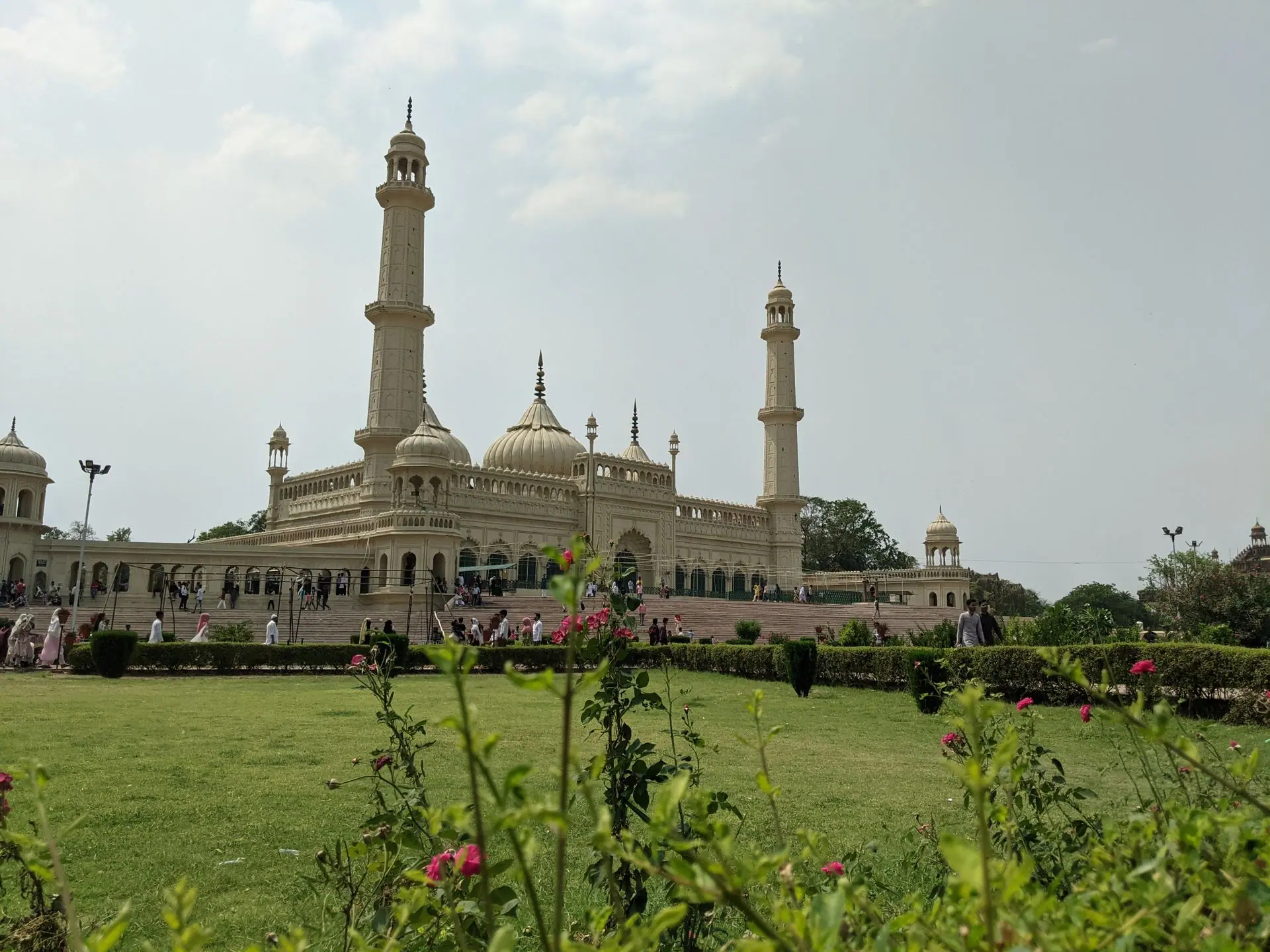
The Bara Imambara, or Asafi Imambara, was commissioned by Nawab Asaf-ud-Daula as famine relief that gave people paid work. The district administration says Kifayatullah's design won a competition and building ran from 1784 to 1791; other official sources date the start to 1780, so the 1780s is as close as the record allows. Its central hall is described as the largest vaulted chamber in the world. A staircase from outside leads to the Bhul Bhulaiya labyrinth, which UP Tourism says visitors may enter only with an authorised guide. The compound holds the Asafi Mosque and the Shahi Baoli stepwell, and Shia Muslims still use it for Azadari.

Rumi Darwaza

This gateway stands outside the north-west corner of the Bara Imambara. The district administration describes an arch of nearly sixty feet and a heavily carved, truncated dome, built of thin burnt bricks in lime mortar and finished in lime plaster rather than the red sandstone of Mughal buildings. Local tradition holds that it copies the Sublime Porte, the gate of the Ottoman government, which is why it is also called the Turkish Gate. It was begun in the same famine as the Imambara. Incredible India says you may see it at any hour and that it looks best lit up at night.

Chhota Imambara

Also called the Husainabad Imambara, the Chhota Imambara was commissioned by Muhammad Ali Shah, the third King of Oudh, who reigned from 1837 to 1842. It holds the tombs of the king and his mother, each behind silver railings, and Belgian crystal chandeliers that are lit during Muharram and other observances. A golden dome and a spire with a crescent and star crown the tomb. The Archaeological Survey of India (ASI) protects and repairs it.

Husainabad Clock Tower

Standing 221 feet tall, the Clock Tower was designed by Richard Roskell Bayne in Moorish style and paid for by the trustees of the Husainabad Endowment, from a legacy left by Muhammad Ali Shah. It has five bells and is lit at night, and it was long believed to be the largest clock tower in the Indian subcontinent. Incredible India lists it among the Residency's nearby attractions, alongside the Imambaras.

Residency and the 1857 Memorial Museum

The Residency was built between about 1780 and 1800 as the residence of the British General in Oudh, a state under East India Company control. In 1857 rebel forces besieged it for over six months, and the ruined mansion still shows bullet holes. The grounds hold a cemetery, with the grave of Henry Montgomery Lawrence among hundreds, as well as the Banquet Hall, the Treasury and a church and mosque. The ASI protects the complex, and the 1857 Memorial Museum inside it has eleven chronological galleries on the uprising and the freedom struggle that followed. Incredible India lists both as closed on Mondays.

Sikandar Bagh

Wajid Ali Shah, the last King of Oudh, built this garden complex for his beloved Sikander Begum, and the district administration dates its completion to 1853. On 16 November 1857 British forces under Sir Colin Campbell breached its walls and killed over 2,000 of the sepoys sheltering inside; the site also commemorates Uda Devi, a woman who fought in the uprising. The district page gives no visiting hours, so ask locally before you go.

Dilkusha Palace

Saadat Ali Khan built Dilkusha, "heart's delight", as a hunting lodge between 1798 and 1814. After 1857 it was judged unsafe and partly dismantled, and today it is a ruin in a landscaped garden. Beside its southern wall lie the graves of British officers and men who died when Lucknow was recaptured, among them Major General Henry Havelock, who died on 24 November 1857. The ASI maintains it.

Maqbara Saadat Ali Khan

Three centrally protected monuments share this campus in Qaiserbagh. The main mausoleum was built by Ghazi-ud-Din Haidar for his father, Saadat Ali Khan, who lies in a vault beneath its dome. The smaller mausoleum of Musheerzadi, Ghazi-ud-Din's mother, stands in the eastern corner. Sapper's Tomb holds the Royal Engineers who died when abandoned gunpowder exploded on 17 March 1858. No timings are published, so check on the day.

La Martiniere College

The palace known as Constantia began as the country house of Major General Claude Martin, a French subject in the service of the East India Company, and it stands in French Baroque style on the west bank of the Gomti. It is now a working school. The district page mentions a chapel and the Claude Martin Museum, but it does not say whether visitors may go in, so ask the college before you plan around it.

Nawabganj Bird Sanctuary

On the plains of Unnao near Lucknow, this 224.6-hectare sanctuary was declared in 1984. Incredible India counts over 250 species, with migratory ducks, geese and teal arriving as winter sets in and resident birds such as the sarus crane. A 2.6 km lakeside trail suits walkers and cyclists, and the listing gives opening hours of 7 am to 5 pm.

Lucknow's food

Incredible India says the Nawabs of Awadh contributed greatly to the city's culinary heritage, and food is a reason to come in its own right. Its list of dishes to try starts with galouti kebab, flat patties fried crisp on both sides, and nalli nihari, a gravy of trotters that locals eat with kulcha, often for breakfast. Add lagan ka murgh, chicken cooked in a wide, heavy-bottomed vessel; mutton biryani; and chaat, from pani puri served with flavoured waters to chana churmura, the local sukha bhel.

For sweet things, look for nankhatai biscuits, aam papad, malai kulfi, and jalebis with badam milk. In winter, malai makhan, a creamy foam with pistachios, is on sale, and a maghai paan after the meal is the traditional finish. Thandai can be made with bhang, a cannabis product, so ask before you order. The same page lists kebab outlets in the old-city markets of Chowk and Aminabad. Our food and water safety guide covers street-food sense.

Things to do in Lucknow

Beyond the monuments, spend an evening at the Rumi Darwaza when it is lit, plan at least one proper meal around the old city's kebabs and nihari, and in winter make time for the bird sanctuary. For trips and experiences across the state, from food walks to the cities that pair with Lucknow, see our Uttar Pradesh tours and experiences and Uttar Pradesh tour packages.

Best time to visit Lucknow

On the IMD's 1991–2020 figures for the city, May is the hottest month, with an average daily maximum of 39.9°C, followed by June at 38.3°C; the hot, dry westerly winds the IMD calls loo blow in May and June. The monsoon arrives in the second half of June and runs to September, bringing about 750 mm of rain, with July at 238.5 mm and August at 241.5 mm. October and November are drier and pleasant, and November is the driest month of the year. The IMD's Lucknow centre puts winter days at 10 to 25°C, but fog settles on mornings and nights from late autumn: on average 7.8 days in November, 17.4 in December, 18.4 in January and 5.8 in February, and it can disrupt road, rail and air services. October to March is therefore the comfortable season, with the foggiest weeks in December and January. Our best time to visit India guide covers the wider picture.

How to reach Lucknow

  • By air: Chaudhary Charan Singh International Airport (LKO) is at Amausi, about 14 km from the centre of the city, with daily flights to cities including Delhi, Mumbai, Bengaluru, Kolkata and Patna.
  • By train: Charbagh, run by Northern Railway, is the largest and busiest station in the city, and Lucknow Junction, run by North Eastern Railway, stands next to it. Our guide to trains and IRCTC for foreigners explains booking.
  • By road: Lucknow is on the Agra Expressway and the Purvanchal Expressway, and buses use the Alambagh Inter-State Bus Terminal, where a Lucknow Metro platform is built into the terminal. Delhi Tourism's distance chart gives 497 km by road from Delhi.

From Lucknow, the cities that complete an Uttar Pradesh route are Ayodhya, Varanasi, Prayagraj and Agra.

How many days in Lucknow

Two days cover the city without hurrying. Spend the first in the old city: the Bara Imambara and its labyrinth in the morning, the Rumi Darwaza, the Chhota Imambara and the Clock Tower after lunch, and kebabs and nihari in Chowk in the evening. Give the second to the 1857 sights, the Residency and its museum, then Sikandar Bagh, Dilkusha and, if you have time, the mausoleum of Saadat Ali Khan. Do not plan either day for a Monday. If you are passing through on the way between Delhi and Ayodhya or Varanasi, one day is enough for the old-city cluster and a meal.

Tips for visiting Lucknow

  • Several sights close on Mondays, so plan around it.
  • The Bhul Bhulaiya admits only authorised guides, and the Bara Imambara is a working place of worship.
  • Hours differ between official listings, so confirm them at the gate.
  • Winter fog can delay trains and flights between December and January; leave slack between connections.

Why book with Experience My India

  • Government-approved operator

    Approved by the Ministry of Tourism, Government of India

  • 500+ vetted local guides

    35+ destination specialists plan every trip by hand.

  • Human help, every day

    Mon–Sun, 9:00 AM – 9:00 PM IST · +91 73022 65809

  • No payment until you approve

    You receive a written quote first; nothing is charged to start planning.

Frequently asked questions

What is Lucknow famous for?

The monuments of the Nawabs of Awadh, above all the Bara Imambara, the Rumi Darwaza and the Chhota Imambara, are its best-known sights, along with the Residency, where the siege of 1857 played out. Its Awadhi food is the other fame, led by galouti kebab and nalli nihari with kulcha. Incredible India also lists chikankari embroidery among its handicrafts.

How many days do you need in Lucknow?

Two days is a comfortable plan: one for the old city, with the Bara Imambara, Rumi Darwaza, Chhota Imambara and Clock Tower, and one for the Residency, Sikandar Bagh and Dilkusha. With only one day, keep to the old-city cluster and spend the evening eating. Avoid Monday, when several of the main sights are closed.

Is Lucknow worth visiting on a first India trip?

It rarely tops a first itinerary, which usually follows Delhi, Agra and Jaipur. It works well as an added stop for a traveller who wants history beyond the Mughals, the story of the 1857 uprising, and a different regional food. Pair it with Ayodhya, Varanasi or Prayagraj.

What is the Bhul Bhulaiya?

It is the labyrinth of zigzag passages on the upper level of the Bara Imambara, reached by a staircase from outside. Incredible India calls it the House of Confusion and says it is said to have 1,024 pathways. UP Tourism says visitors may enter it only with authorised guides, so you do not go in alone.

Which Lucknow sights are linked to the 1857 uprising?

The Residency and its 1857 Memorial Museum record the six-month siege; Sikandar Bagh marks the assault of 16 November 1857; Dilkusha holds the graves of British officers, including Major General Henry Havelock; and Sapper's Tomb, in the Qaiserbagh campus of Saadat Ali Khan's mausoleum, commemorates engineers killed in an explosion in March 1858.

Which Lucknow sights close on Mondays?

Incredible India lists the Bara Imambara, the Residency and the 1857 Memorial Museum as closed on Mondays. Its hours are 9 am to 5 pm for the Imambara, 10 am to 5 pm for the Residency and 10 am to 5.30 pm for the museum, though an older UP Tourism page gives sunrise to sunset for the Imambara. Confirm the day's hours at the gate.

What should you eat in Lucknow?

Start with galouti kebab, nalli nihari with kulcha, lagan ka murgh and mutton biryani, then chaat such as pani puri and chana churmura. Finish with kulfi, jalebis with badam milk, or in winter malai makhan, and a maghai paan. Incredible India lists kebab outlets in Chowk and Aminabad, in the old city.

How far is Lucknow from Delhi, and how do you get there?

Delhi Tourism's distance chart gives 497 km by road. Lucknow's airport, Chaudhary Charan Singh International, has daily flights from Delhi according to the district administration, and Charbagh and Lucknow Junction stations are on the rail network. We have not checked train times, so look them up on IRCTC.

From the journal: Lucknow

Customer reviews

Experience My India is rated 4.3 on Tripadvisor. We publish guest reviews after each trip.

Read our reviews

Plan a trip

Tailor-made quote from a specialist